Close
Try Your Luck
With Mozaico
With Mozaico

Try Your Luck
With Mozaico
With Mozaico
Email Already Subscribed

we ship worldwide

money back guarantee

exclusive

630.300.3942
What can we help you with?
Shipping & Taxes. FAQ.630.300.3942
What can we help you with?
How to install a mosaic.Get one-on-one expert advice from our lead designer to help you transform any area around your home or work.
Fill out the form below to submit your designer question.
Take a picture of a room in your home, a floor area or a table top that you would like to ask a question about - or simply anything you would like to make into mosaics.

With deep and sacred meaning, the “Tree Of Life” became a spiritual icon in many of the world’s cultures and religions. The tree was associated with both the negative and the positive or duality, even in Christianity. It first appeared in the book of Genesis, as being planted with the tree of knowledge.
Many cultures observe the verve and fate of trees, and the seasonal death and revival of their foliage, as spiritual motifs of rebirth, renewal, and death. As it mediates between Eden and earth, with roots that lever deep into the soil and twigs that embrace the heaven. It’s a celestial symbol of the soul’s journey through the third density world of spiritual and mundane aspects.
This article traces its meaning back to the ancient times, taking a closer look at the “Tree of Life” symbolism, and delve into its origins and history to uncover a deeper esoteric significance.

With their majestic beauty and aromatic foliage, trees appear as a majestic sight in any landscape. Their magnificent shape made them the subject of divination for many ancient civilizations. “The Tree of Life” symbolized wisdom and harmony with nature. From the Andes Mountains of South America to the coasts of China, passing through the mountains of Greece, their fragrant resin was burnt as the offering of gods, deities, priests and kings in countless temples.
One of the most unanswered questions in the history of mankind is our desire to know what happens next. The very question had given way to a long series of predictions, worship and divination which contemplated our plane of existence. Trees have been matters of devotion in all parts of the world. Partly because of this, they still have a tight liaison with Christmas customs and traditions. In Hinduism as well as Buddhism both appear to have involved a sort of devotion for the renowned Bodhi and Banyan trees. While in European mythology the best-known exemplar is the tree Yggdrasil. Hence, countless of popular stories throughout the world revealed a firmly rooted belief in these majestic sights.
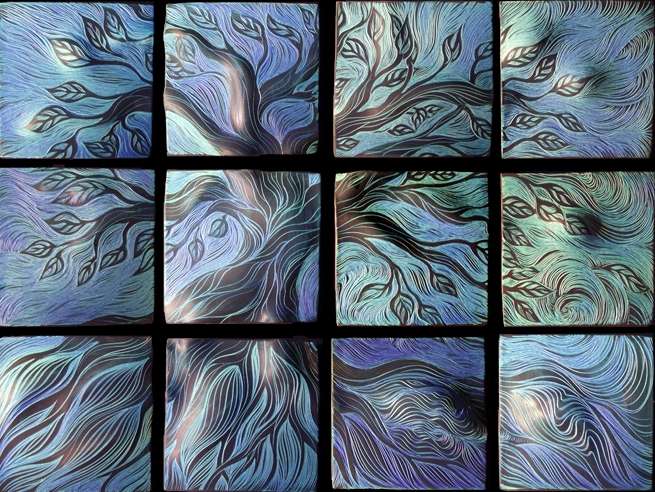
In one way or another, the tree of life has always been depicted in numerous and diverse works of art. Shown as a mythical or contemporary structure, and asserted as an ethical framework. This measure of absolute has also been a source of inspiration for thousands of sculptors and mosaic designers. Its concept has shaped a conceptual relationship between the artist and the observer.

Manav Gupta studied the tree of life’s form and its spiritual significance. He was also interested in the Tree of life’s connection with the substantial reality and perception. The artist created the world’s tallest and largest three-dimensional “Tree of Life Mural”. His masterpiece covers 5,000 sq ft of evident frontage and around 10,000 sq ft of total painted frontage. This Tree of life mural became an emblem of the Gurgaon neighborhood in India. This contemporary artwork denotes in the methodology of creation and creativity.

Today, the tree of life is a source of inspiration for many artists and authors and it will continue to be a muse for many creators around the world. It has also acclimatized emblematically in literature and cultural practice. These practices, moreover, were conceived as an ideogram of intensely rooted archetypes in the human psyche and their emblem looms in the metaphors of modern society.
Features Tile Art: Courtesy Of Nathalie Blake
What else would you have liked to have seen in this article?
Have any other thoughts or questions about the “Tree of Life” ? Let us know in the comments below.
Got inspired by reading this article? You May Also Want To Read: Conceptual Art: Visualizing Temporal Data


 English
 French
 German
 Italian
 Portuguese
 Russian
 Spanish