Close
Try Your Luck
With Mozaico
With Mozaico

Try Your Luck
With Mozaico
With Mozaico
Email Already Subscribed

we ship worldwide

money back guarantee

exclusive

630.300.3942
What can we help you with?
Shipping & Taxes. FAQ.630.300.3942
What can we help you with?
How to install a mosaic.Get one-on-one expert advice from our lead designer to help you transform any area around your home or work.
Fill out the form below to submit your designer question.
Take a picture of a room in your home, a floor area or a table top that you would like to ask a question about - or simply anything you would like to make into mosaics.

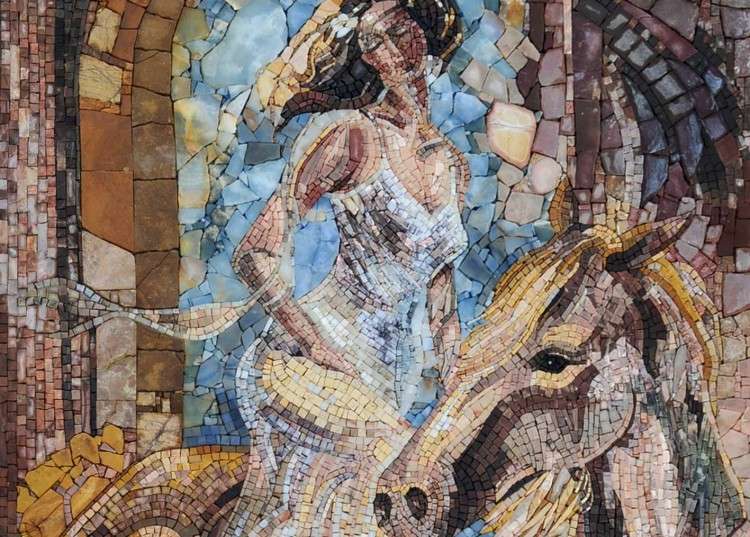
Cover Photo: by Solomatina Anna, www.arthit.ru
Looking for new ways to understand artworks?
Have you explored Impressionism?
Unlike traditional mosaics relying on accurate lines and details, impressionist mosaics are created with natural flaws. Mosaic Impressionism is archetypal to impressionist painting techniques. Paintings are usually made with small strokes of pure colors. While impressionist mosaics are made with scientific studies of color to manifest the effects of light and saturation.
In this article you will discover what Impressionism is really about and how to understand this art movement!
The Art Story: Impressionism
Impressionism is one of the first striking modern art movements in painting. The 1860’s and 1870’s had seen the development of Impressionism in Paris. Its influence has broadened throughout Europe and in due course the United States.Impressionism was born in turning away from the faultless finish and detail to which most artists of their day desired adapted. The movement aimed to capture impressions and intuitive effects of a scene. To make the effect more credible, many Impressionist artists left their workshops and went to the streets and countryside, to paint en plein air.
Rather than probing on details, artists shaped an impression with thick and short brush strokes. Juxtaposed colors were often applied with as little color mixing as possible. Thus has created a vibrant color temperature, mixed in the eye of the beholder. Impressionist surfaces are often opaque and dense. To create a color reflection from one object to another, artists gave a close attention to highlighting with natural light.

Photo: by Solomatina Anna, www.arthit.ru
Impressionists mosaic designers, loosened their symmetric tile cut and lightened their tesserae to include pure, intense hues. What is the main visual element in impressionism mosaics? Well, color of course! Impressionist mosaic artists value the fact of color existence in shadows. According to this theory, artists have started creating their mosaic designs.
The main idea of impressionism is to portray the artist’s intuitive impression. The challenge is to make this impression obvious to the eyes of the beholder. Nevertheless, creating precise details of a reality as seen by the artist is not adapted in the impressionist technique. Therefore, using dark tiles to create shadows and details was swapped by bright colors. In order to create an impressionistic mosaic artwork, defined shapes has to be replaced by minor details, an Impression! Primary and complementary colors, will bring out the best of tesserae.

Copyright ©Mozaico Art, 2015. All rights reserved.
Portfolio: www.mozaico.com
Now that you have learned about impressionist mosaics, would you think of owning or creating an impressionist mosaic artwork?
Share your thoughts with us in the comment box below.
Did you enjoy this article?
You may also want to read:
New Vision of an ancient medium: Glass Mosaic Tiles
Don’t Forget to Subscribe to our Newsletters for More Updates on Mosaic Art, Decor, Creativity and Much More!


 English
 French
 German
 Italian
 Portuguese
 Russian
 Spanish