Close
Try Your Luck
With Mozaico
With Mozaico

Try Your Luck
With Mozaico
With Mozaico
Email Already Subscribed

we ship worldwide

money back guarantee

exclusive
630.300.3942
What can we help you with?
Shipping & Taxes. FAQ.630.300.3942
What can we help you with?
How to install a mosaic.Get one-on-one expert advice from our lead designer to help you transform any area around your home or work.
Fill out the form below to submit your designer question.
Take a picture of a room in your home, a floor area or a table top that you would like to ask a question about - or simply anything you would like to make into mosaics.


Mosaic is the most public of art forms. It survives weather, it survives being walked on, and it is almost never behind glass — which means the best of it is on streets, in stations and on the sides of buildings, free to look at.
Ten cities where that is worth a detour, starting with the one nobody argues about.
Antoni Gaudí did more for mosaic than any architect since the Byzantines, and he did it with broken tile. Trencadís — the technique of covering curved surfaces in irregular ceramic shards — solved a real problem: flat tiles will not follow a compound curve, but fragments will.
Park Güell is the place to start, for the serpentine bench that runs the length of the main terrace and for the lizard on the entrance stair. Casa Batlló has the façade and the scaled roof. Both are busy; both are worth it.
Our guide to Gaudí mosaics covers the technique in more detail.

Philadelphia's Magic Gardens on South Street is the largest work by Isaiah Zagar, who has been covering the city in mosaic for decades. It spans several lots, indoors and out, and is built from whatever came to hand — mirror, bottles, bicycle wheels, broken china, tile.
It is also only the beginning. Zagar's mosaics are spread across dozens of walls in the surrounding streets, so the Gardens are best treated as the start of a walk rather than the whole visit.

Chartres is famous for stained glass, which makes its great mosaic work easy to miss. Maison Picassiette is a house that Raymond Isidore, a cemetery sweeper, spent decades covering in mosaic made from broken crockery he collected — walls, floors, ceilings, furniture, the garden, the outside of the building. He worked on it from the 1930s until his death.
It is the best example anywhere of mosaic as an obsession rather than a commission, and the name is a pun: assiette is a plate.


Two very different things here.
The Selarón Steps climb between Lapa and Santa Teresa, covered over twenty years by Jorge Selarón in tiles sent to him from all over the world. The dominant yellow, green and blue are the colours of the Brazilian flag, and a few hundred of the tiles he painted himself.
The Copacabana promenade is the other: a black and white wave pattern in Portuguese pavement running the length of the beach. It is mosaic at a scale most people walk over without noticing.

Linh Phuoc Pagoda is covered — towers, dragons, columns, interior — in mosaic made from broken glass, bottles and ceramic. The dragon in the grounds is built from many thousands of bottle fragments.
It is the clearest demonstration anywhere of what the medium does with waste: nothing here started life as a tessera.
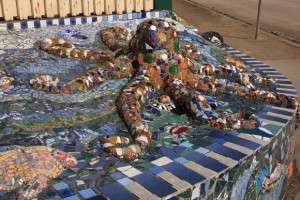
A small coastal town on the New South Wales coast with a long community mosaic along its seafront — dolphins, octopus and fish worked in glass tile, pottery and broken china, much of it contributed by residents.
Community mosaic is a genre of its own, and this is one of its better examples: made by many hands over a long period, in a place with no particular claim to be an art destination.

Persian tilework is a separate tradition from the Greco-Roman line, and in some respects a more technically demanding one. At the Jame Mosque of Yazd, the entrance portal is faced in turquoise and cobalt tile and flanked by the tallest minarets in Iran.
The patterns are geometric and vegetal rather than figurative, which is the governing convention in Islamic art, and the complexity is in the mathematics. See our guide to Islamic mosaic art.
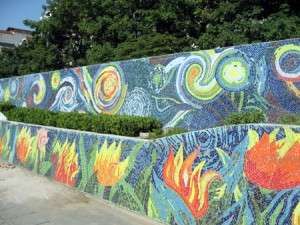

The Hanoi Ceramic Mosaic Mural runs for several kilometres along the Red River dyke and holds the Guinness World Record as the largest ceramic mosaic. It was completed in 2010 for the thousandth anniversary of the city's founding — the 1010–2010 dating is worked into the mural itself.
It was made by a large group of Vietnamese and international artists, and the subject changes as you walk: historical scenes, traditional patterns, landscapes, children's drawings.


London's mosaics are mostly underground, and the best of them are overlooked daily by people in a hurry.
Tottenham Court Road station carries Eduardo Paolozzi's mosaics, installed in 1984 — a riot of abstract and mechanical imagery across the passageways and platforms. They are the most significant mosaic installation in Britain, and survived a serious fight to save them during the station rebuild.
Leytonstone station has seventeen mosaics commemorating Alfred Hitchcock, who was born nearby. Installed in 2001 by the Greenwich Mural Workshop using roughly 80,000 tiles, they run through his films scene by scene — including the crop-duster sequence from North by Northwest.
The Queenhithe mosaic on the Thames path is a long frieze narrating London's history in sequence, from Roman settlement through the Great Stink and the First World War air raids. In Carlisle Lane, near Waterloo, Southbank Mosaics made a series illustrating the poems of William Blake, who lived in Lambeth.


The subway is the gallery. Mosaic has been part of the system since the 1900s, when Squire Vickers established the station-identification tablets and decorative plaques that are still in place, and the MTA has kept commissioning ever since.
At 50th Street, Liliana Porter's Alice in Wonderland figures have occupied the platform walls since 1994. At Allerton Avenue in the Bronx, Michele Brody's mandala patterns were installed in 2006. There are hundreds of others, and the pleasure of it is cumulative rather than concentrated — you see them by travelling, not by visiting.
Not on the list above because it is not a city you go to for anything else: Ravenna, in Italy, holds the finest concentration of mosaic anywhere, and it is not close. Eight buildings, fifth and sixth century, gold grounds throughout. Our guide to Byzantine mosaics explains what is there and why it survived.
Mosaic wall art · Custom mosaics · Commercial projects
Ravenna in Italy, for the Byzantine work, and Barcelona for Gaudí's broken-tile mosaics. If the question is about living mosaic artists rather than historic monuments, Philadelphia has the densest concentration, thanks to Isaiah Zagar.
Ravenna is the traditional answer — it has a long-established mosaic school and working studios alongside the ancient monuments. Philadelphia's South Street area is the modern equivalent.
The Hanoi Ceramic Mosaic Mural in Vietnam, which holds the Guinness World Record as the largest ceramic mosaic. It was completed in 2010 for Hanoi's thousandth anniversary.
Tottenham Court Road station for Eduardo Paolozzi's 1984 mosaics, Leytonstone station for the seventeen Hitchcock mosaics, the Queenhithe mosaic on the Thames path, and Carlisle Lane near Waterloo for the William Blake series by Southbank Mosaics.
The subway. Liliana Porter's Alice in Wonderland mosaics at 50th Street and Michele Brody's mandalas at Allerton Avenue are among the best known, but the system holds hundreds, going back to the station tablets of the 1900s.
The technique of covering a surface in irregular fragments of broken tile, used by Gaudí and the Catalan modernists. It exists because flat tile cannot follow a curved surface and broken pieces can.
Yes. The Jame Mosque of Yazd in Iran for Persian tilework, the Hanoi Ceramic Mosaic Mural and Linh Phuoc Pagoda in Vietnam, the Selarón Steps in Rio, and Philadelphia's Magic Gardens.


