Close
Try Your Luck
With Mozaico
With Mozaico

Try Your Luck
With Mozaico
With Mozaico
Email Already Subscribed

we ship worldwide

money back guarantee

exclusive

630.300.3942
What can we help you with?
Shipping & Taxes. FAQ.630.300.3942
What can we help you with?
How to install a mosaic.Get one-on-one expert advice from our lead designer to help you transform any area around your home or work.
Fill out the form below to submit your designer question.
Take a picture of a room in your home, a floor area or a table top that you would like to ask a question about - or simply anything you would like to make into mosaics.

If we could travel back in time to early antiquity, we would witness a great variety of techniques, insights and influences in art and especially mosaic and stone art. Mosaics were firstly created from pebbles, which were naturally colored later. By 200 BC, history introduces the hand cut stone Tesserae, still recognizable and trendy in our time. Tesserae is an individual tile usually handcrafted in the shape of a cube and used in Ancient Roman decorative mosaic panels and floor inserts. Marble or limestone tesseras were cut into small cubes to form dazzling designs and geometric patterns. A couple of years later, tesseras were made from colored or clear glass backed with metal foils. The middle Byzantine artists used to combine tesserae with gold leaf, often used for gilding. Today there’s a wide range of contemporary tesserae tiles, from vitreous glass to ceramic tesserae to smalti, gold smalti, mirror and stained glass. Join the boat and let us sail through the history and modernity of mosaic and stone art.
Through a varied toolbox of nippers, cutters and hammers, Sonia King handcrafts each tesserae giving it a unique insight. Although she sticks to the main tesserae shape and scale but she never grinds edges. She uses either a wet saw or power tools. She indulges herself in the physical connection of existing and creating. For Sonia, mosaic art isn’t just about cutting a piece that fits. This made her create through a broad range of material. Her work becomes technically thoughtful when she tries to make every tesserae right while creating a profound connection between a piece and another.


Pebble mosaic stone artworks are usually inserted in patios, backyards and gardens. Artists and artisans usually use pebbles as an affordable and natural art supply to handcraft mandalas, medicine wheels, division cells, energy waves, spirals, snakes and of course floral designs. At time artists add colored marble, while other times they just prefer to keep it simple and slight. Pebbles aren’t just a medium to decorate backyards and patios but also an art medium to craft stepping stones, pathways, walls, steps, pounds and fountains. Since pebble stones are inexpensive and durable, they will slowly start being part of our indoor spaces.


Carol Deutsch is an award-winning mosaic artist. Her rock mosaics are a unique form of garden art that adds gleaming movement to any backyard or garden. This original rock art combines natural stones with glass inlays in the shape of dragonflies, hummingbirds, butterflies, fish, and much more. She creates these rocks in her home studio, inspired by the brashly brilliant colors of her patio.

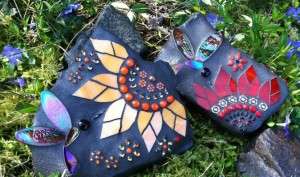


The Opus Sectile technique is a stone art technique all raged in the ancient and medieval Roman world. They cut materials to hatch them into walls and floors creating artistic murals or floor insert patterns. Opus sectile is definitely uncommon to the tessellated mosaic technique, where the inlay of tiny and equally sized tiles creates a mosaic stone artwork. Opus sectile pieces are usually much larger and can be shaped to detail large parts of any design. Marble, glass and mother of pearl were the common material used in the sectile technique. Artisans used to cut these tiles in thin pieces, polish to trim them later according to the explicit pattern. Even though the technique died in Rome through the decline of the Empire, it sustained itself in Byzantine Churches, mainly in floor inserts. In the late 19th century, the Opus Sectile mosaic technique was revived by England Charles Hardgrave during the Whitefriars Glassworks.
The following mosaic art pieces comply with the Opus Sectile technique and are made by Mozaico artisans.
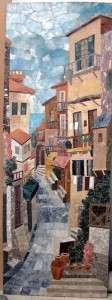


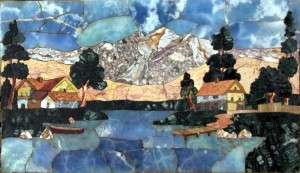


Last but not least, the water jet cutting technique is just perfectly made and shaped. Water jet is nowhere near Tesserae tiling or the Opus sectile technique and definitely not typical to pebble stone art or garden stones. Computerized water jet creates precisely cut edges. Artists and mosaic artisans see the water jet cutting technique as a very helpful and cooperative way to have an impressively made mosaic. The water jet process uses the most up to date technology to create fresh design concepts.


Click On Any Picture to be redirected to the website and read more about the artworks featured.
Do you like this post? Then you may also want to learn about Roman Mosaic Discoveries made through time…
Don’t Forget to Subscribe to our Newsletter for More Updates on Mosaic Art, Decor, Creativity and Much More!


 English
 French
 German
 Italian
 Portuguese
 Russian
 Spanish
2 comments
Thank you so much for your kind words! We’re glad you enjoyed our post on the 5 Must-Know Mosaic Stone Art Techniques. Happy creating! 🌟
Exelente publicación, muchas gracias