Close
Try Your Luck
With Mozaico
With Mozaico

Try Your Luck
With Mozaico
With Mozaico
Email Already Subscribed

we ship worldwide

money back guarantee

exclusive
630.300.3942
What can we help you with?
Shipping & Taxes. FAQ.630.300.3942
What can we help you with?
How to install a mosaic.Get one-on-one expert advice from our lead designer to help you transform any area around your home or work.
Fill out the form below to submit your designer question.
Take a picture of a room in your home, a floor area or a table top that you would like to ask a question about - or simply anything you would like to make into mosaics.

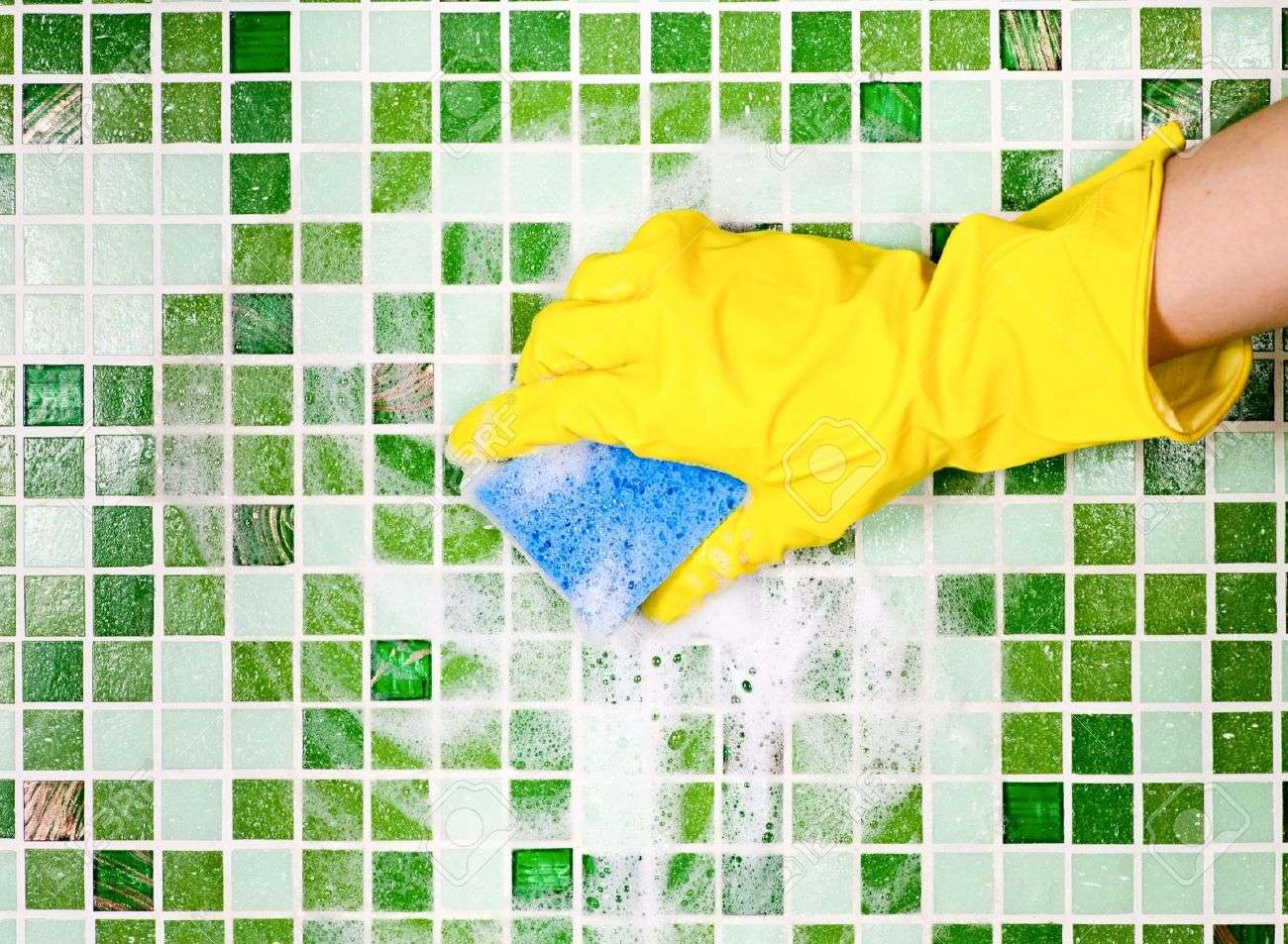
Mosaic is one of the lowest-maintenance surfaces you can own. Nearly all of the damage it does suffer comes from cleaning it with the wrong thing.
So before anything else: find out what your mosaic is made of. Stone and glass need opposite treatment on one critical point, and getting it wrong is not reversible.
If your mosaic is natural stone — marble, travertine, limestone, onyx — never use anything acidic on it. No vinegar, no lemon, no bleach, no bathroom descaler, no generic “tile and grout” cleaner unless it explicitly says pH-neutral and stone-safe.
Most mosaic is stone. Around 90% of ours is marble, and that is typical of handmade work. So if you are not sure what you have, treat it as stone and use a pH-neutral cleaner. You cannot damage glass or ceramic that way, but you can certainly damage marble with a cleaner meant for glass.

This is the distinction almost every cleaning guide misses, and it causes real damage.
A stain is something sitting in the stone — wine, oil, rust. It can be drawn back out.
An etch is a chemical burn. Acid dissolves the calcium carbonate in marble and leaves a dull, slightly rough patch where the polish used to be. It is not dirt. It is a small crater. No amount of further cleaning will lift it, and scrubbing harder only widens it.
The practical consequence: if a patch of marble has gone dull after a spill or a clean, stop. More cleaning makes it worse. Light etching can be re-polished with a marble polishing compound; anything deeper needs a stone restoration specialist.
Lemon juice, vinegar, tomato, wine, many bathroom cleaners and most limescale removers will all etch marble. Coasters exist for a reason.
| Material | Use | Never use |
|---|---|---|
| Marble, travertine, limestone, onyx | pH-neutral stone cleaner, or warm water with a little mild dish soap | Vinegar, lemon, bleach, descaler, abrasive cream |
| Granite | pH-neutral cleaner; more forgiving than marble but still not acid-proof | Strong acids, abrasive pads |
| Glass and smalti | Mild soap and warm water; a dilute vinegar solution is fine | Abrasive pads or powders — they scratch glass permanently |
| Ceramic and porcelain | The most forgiving. Mild detergent, or dilute vinegar | Very little, though heavy abrasives can dull a glaze |
| Metal | Soft microfibre, buffed dry to prevent water marks | Anything abrasive, and prolonged standing water |
A simple test if you genuinely cannot tell: put a drop of vinegar on an inconspicuous corner and wait a minute. If it fizzes faintly or leaves a dull mark, it is calcareous stone — marble, travertine or limestone — and acid is off the table. Rinse it off immediately either way.
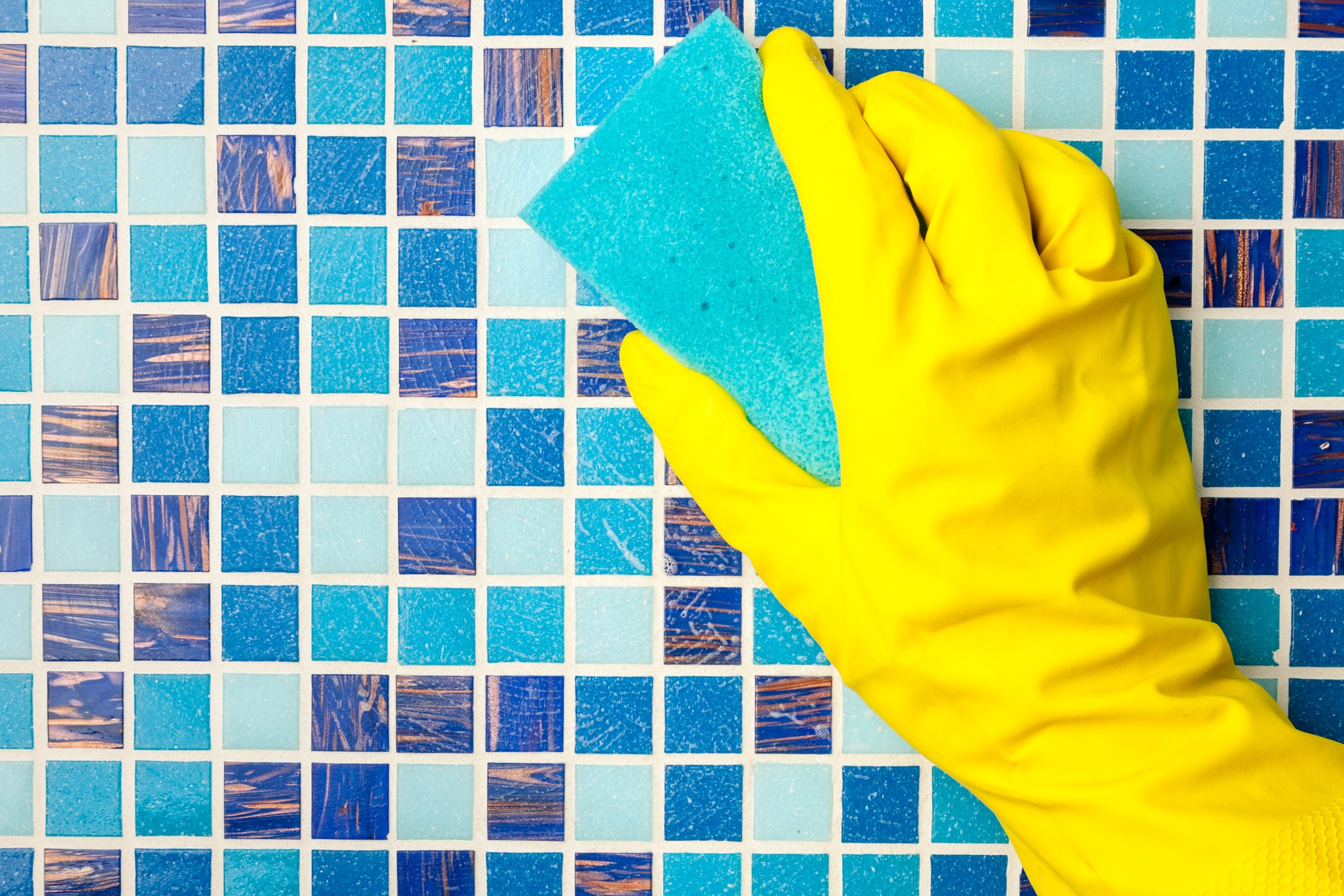
Little and often beats occasional deep cleaning, which is where aggressive products get reached for.



Grout is usually the part that looks dirty, not the tesserae. It is porous, it sits slightly below the surface, and it collects everything.
For routine cleaning, a soft brush — an old toothbrush is ideal on a small panel — with warm soapy water. For stubborn discolouration on a non-stone mosaic, a paste of bicarbonate of soda and water, left for ten minutes and brushed off, lifts most of it. On stone, check that any proprietary grout cleaner states it is safe for natural stone: plenty are acidic precisely because acid shifts grout stains quickly.
Two things that are not worth doing: steam cleaners, which can drive moisture behind the tesserae and soften older adhesive, and bleach, which weakens cement-based grout over time even where it does not touch the stone.
A specific problem with a specific answer, because it comes up constantly after installation and the usual advice makes it worse.
Grout haze is a thin film of cement residue left across the face of the tiles. On glass it is very visible, because glass should be reflective.


Sealing does not make stone waterproof. It buys you time — it slows absorption so a spill sits on the surface long enough to be wiped up instead of soaking in.
| Where | How often |
|---|---|
| Walls and backsplashes indoors | Every 2–3 years |
| Floors indoors | Annually, or whenever water stops beading |
| Showers and wet rooms | Annually |
| Outdoors and pool surrounds | Annually, mostly to protect the grout |
The test is simple: splash a little water on and wait five minutes. If it beads, the seal is working. If it darkens the stone, it is time to reseal.
Seal when the surface is completely clean and completely dry, otherwise you seal the dirt in. Glass does not need sealing; the grout around it often does.


Showers. The enemy is soap scum and hard water, not dirt. Squeegee the walls after use and almost no cleaning is needed. For existing build-up on stone, use a stone-safe soap film remover — not a limescale product, which is acidic by design.
Pools. Chlorine and pool chemistry are hard on grout rather than on tesserae. Keep an eye on the waterline, where scale accumulates, and have the grout checked periodically.
Outdoors. Wash down occasionally and reseal annually. The real risk is not dirt but water getting behind the panel and freezing, so make sure drainage is working and re-fix any loose tesserae promptly — see mosaic garden art for how that is set up properly in the first place.
A loose tessera is a small job and an urgent one — water getting behind it will loosen its neighbours. Clean out the cavity, re-bed it with an appropriate adhesive, re-grout.
A missing tessera can be replaced. This is mosaic's great advantage over every other art form: damage is local. Lose a piece of a painting and it is gone; lose a tessera and you replace a tessera.
Dull or etched marble needs polishing, not cleaning. A marble polishing compound handles light etching; deeper damage is a job for a stone restorer.
Cracked grout should be raked out and replaced rather than patched over, and it is worth asking why it cracked — usually movement in the substrate, which will keep happening.
How to hang mosaic art · Tesserae and mosaic stones · All mosaic designs · Custom mosaics
Dust or vacuum first, then wash with warm water and a little mild soap, and dry with a microfibre cloth. The only critical decision is the material: if it is natural stone, use nothing acidic.
On glass, ceramic and porcelain, yes, diluted. On marble, travertine, limestone or onyx, never — vinegar etches the stone, leaving dull patches that cleaning cannot reverse. Most handmade mosaic is stone, so if in doubt, do not.
A pH-neutral stone cleaner, or simply warm water with a small amount of mild dish soap. It is safe on every material, which is why it is the right default.
The problem is soap scum and hard water rather than dirt. Squeegee after use and build-up largely stops. For existing film on stone, use a stone-safe soap film remover rather than a limescale product, which is acidic.
Within a day or two, a damp sponge and a dry microfibre buff. Once cured, use a grout haze remover — and if there is any stone in or near the mosaic, choose a pH-neutral one, because the acidic kind will etch it. Never use a scouring pad or blade on glass.
Indoor walls every two to three years, floors and showers annually, outdoors annually. Test by splashing water on: if it beads, the seal is still working.
That is etching, not staining — acid has physically damaged the polished surface. Cleaning will not fix it and scrubbing makes it worse. Light etching responds to a marble polishing compound; deeper damage needs a stone restorer.
Better not to. Steam can drive moisture behind the tesserae and soften older adhesive, particularly on vertical surfaces and anything more than a few years old.


