Close
Try Your Luck
With Mozaico
With Mozaico

Try Your Luck
With Mozaico
With Mozaico
Email Already Subscribed

we ship worldwide

money back guarantee

exclusive
630.300.3942
What can we help you with?
Shipping & Taxes. FAQ.630.300.3942
What can we help you with?
How to install a mosaic.Get one-on-one expert advice from our lead designer to help you transform any area around your home or work.
Fill out the form below to submit your designer question.
Take a picture of a room in your home, a floor area or a table top that you would like to ask a question about - or simply anything you would like to make into mosaics.


Almost nothing survives from the ancient world at full size and in its original colour. Paintings faded, textiles rotted, wooden panels burned. Mosaics did not — because a mosaic is made of stone and glass, and because the thing that destroyed most ancient buildings, collapse, is also what buried and protected their floors.
So the mosaics below are not reconstructions or fragments behind glass. They are the actual surfaces, in the actual rooms, in the colours they were laid in — some of them seventeen centuries ago. This is a guide to where they are and what to look for when you get there.
| Site | Where | Date | What to look for |
|---|---|---|---|
| Villa Romana del Casale | Piazza Armerina, Sicily | 4th c AD | The Great Hunt corridor and the “Bikini Girls” |
| Zeugma Mosaic Museum | Gaziantep, Turkey | 2nd–3rd c AD | The Gypsy Girl |
| National Bardo Museum | Tunis, Tunisia | 2nd–5th c AD | Virgil with the muses; Ulysses and the Sirens |
| Great Palace Mosaic Museum | Istanbul, Turkey | 6th c AD | Everyday scenes, no religion at all |
| Sant’Apollinare Nuovo | Ravenna, Italy | 6th c AD | The processions — and the erased figures |
| Santa Maria Maggiore | Rome, Italy | 5th c AD | Old Testament panels in the nave |
| Santa Costanza | Rome, Italy | 4th c AD | Pagan vintage scenes in a Christian tomb |
| Huqoq synagogue | Galilee, Israel | 5th c AD | Samson, and a Hebrew inscription |
| The Madaba Map | Madaba, Jordan | 6th c AD | The oldest surviving map of the Holy Land |
| Jāmeh Mosque of Yazd | Yazd, Iran | 12th c | Faience mosaic under the dome |
| Akbar’s mausoleum | Sikandra, Agra, India | completed 1613 | Inlay blending four religions |
| The Great Pavement | Westminster Abbey, London | 1268 | Cosmati work, and a dated inscription |
The single best place on earth to understand what a Roman floor actually was. This 4th-century country villa was buried by a landslide, and excavation from 1929 onward uncovered more than 3,500 square metres of mosaic floor in near-perfect condition — the largest and richest collection surviving anywhere.
Two floors draw the crowds. The Great Hunt corridor runs sixty metres and shows the capture and shipping of wild animals for the arena: tigers, elephants, a rhinoceros, and the men handling them. It is a documentary about the Roman supply chain, laid in stone.
The other is the so-called “Bikini Girls” in the Chamber of the Ten Maidens — young women running, throwing a discus and lifting weights in two-piece athletic dress. It is the most reproduced Roman mosaic in the world, and the reason is simple: it looks modern, and nothing else from antiquity does.
The largest mosaic museum in the world, holding over 1,700 square metres of Roman floors. It opened in September 2011, and it exists because of a rescue: Zeugma was a wealthy garrison and toll city on the Euphrates, and when a dam threatened to flood the site, excavation turned up villa after villa of mosaic.

One face dominates the collection. The Gypsy Girl is a fragment — just a head, cut from a larger floor — and the gaze follows you across the room, which is an effect the mosaicist built deliberately out of the way the tesserae curve around the eye. Twelve looted pieces of the same floor were returned to Turkey in 2018 after decades in a United States university collection.
Roman North Africa was mosaic country, and the Bardo holds what came out of it — so much that mosaic occupies more than half the building.

The most important piece is not the most beautiful. It is a 3rd-century panel showing the poet Virgil seated with a scroll of the Aeneid on his knees, flanked by two muses: Clio, history, and Melpomene, tragedy. It is generally described as the only surviving portrait of Virgil from the ancient world, which means every face of Virgil you have ever seen descends from this floor in Tunisia.
Alongside it: the Triumph of Neptune from the 2nd century, the god riding at the centre of the four seasons; the 5th-century Seignior Julius mosaic from Carthage, showing a great estate with its owner, his wife and the workers who made him rich; and a 3rd-century Ulysses and the Sirens, Ulysses lashed to the mast of his ship.
Recovered between 1935 and 1954 from the peristyle courtyard of the Great Palace of Constantinople, and laid in the reign of Justinian I. What makes this floor unusual is what is missing from it: there is almost no religion and almost no emperor.

Instead there are children, farmers, animals and hunters — a boy feeding a donkey from a basket, a woman carrying a pot, a man milking a goat. For a court that spent its resources on gold and theology, the palace floor is a surprisingly domestic thing, and it is the best surviving evidence of what Byzantine secular art looked like.
Ravenna is the mosaic capital of Europe, and this 6th-century basilica holds its most instructive walls. Above the arcade run two long processions: twenty-two virgins approaching the Madonna on one side, twenty-six martyrs approaching Christ on the other, with the port of Classe and the city of Ravenna at the ends. Above those, two registers of smaller panels — thirteen scenes of Christ’s miracles on one wall, thirteen of the passion and resurrection on the other.

Look at the columns in the palace scene. The church was built by Theodoric the Great for Arian worship, and when it was reconsecrated to orthodox Christianity the figures of Theodoric and his court were cut out of the mosaic and replaced with curtains. The erasure was not quite complete: several disembodied hands remain on the columns, left behind by whoever did the editing. It is the clearest case of political censorship visible in any ancient artwork.
A legend attaches to the basilica too — that Pope Gregory the Great wanted the mosaics blackened because their glitter distracted the congregation from prayer. It is almost certainly not true, but it tells you what these surfaces did to a room lit by candles.
Two Roman churches worth the detour for mosaic specifically.
Santa Maria Maggiore holds mosaics commissioned by Pope Sixtus III in the 5th century: Old Testament scenes along the nave, and on the triumphal arch a sequence showing the Virgin at successive moments of the story. It is one of the richest surviving early Christian mosaic schemes anywhere.
Santa Costanza is stranger and more revealing. Built as a mausoleum for Constantine’s daughter, its vault is covered in pagan vintage scenes — grape harvest, wine making, birds and foliage — in a Christian imperial tomb. It is a snapshot of the moment the two visual languages had not yet separated.
The newest entry on this list, and still growing. Excavation of a 5th-century synagogue floor began in July 2012 and has produced one extraordinary panel after another.

The first find showed Samson tying torches between the tails of foxes, alongside human faces circling a medallion whose Hebrew inscription promises reward for good deeds. A second, better preserved Samson emerged in 2013. In 2018 came men carrying grapes and a child leading an animal.
The colours are the thing. These cubes were underground for fifteen centuries, and they came up looking as though they had been set last year — which is the clearest demonstration available of why anyone chose this medium in the first place.
Set into the floor of Saint George’s Greek Orthodox Church in Madaba is the oldest surviving map of the Holy Land — a 6th-century mosaic covering the Near East from Lebanon to the Nile Delta, and from the Mediterranean to the eastern desert.


It was not decoration. The map was a working instrument for pilgrims moving between holy sites, with towns, rivers and routes labelled in Greek, and its depiction of Jerusalem — walls, gates, the colonnaded main street — is detailed enough that archaeologists have used it to locate buildings on the ground.
The wider Madaba plateau holds mosaics from the 1st to the 8th centuries AD, which is why the town calls itself the City of Mosaics. Its animal mosaics tend to be damaged, and for a specific reason: figurative images fell out of favour in the early 8th century and many were deliberately broken up and reset.
A different tradition entirely, and a useful corrective if you think mosaic means Roman figures. The 12th-century Friday Mosque of Yazd is faced in faience mosaic — glazed tile cut into precise geometric pieces and assembled into patterns rather than pictures.
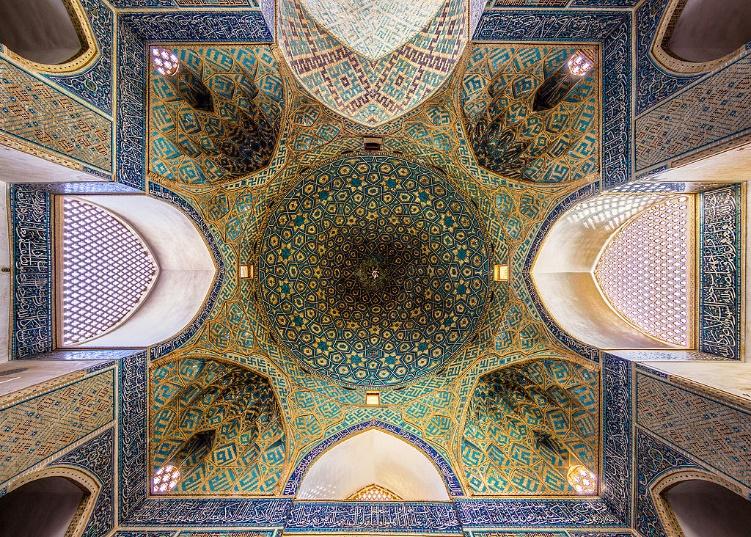
Walk through the courtyard to the sanctuary chamber and look up. The dome is worked in blue and turquoise tilework of extraordinary density, with the pattern resolving differently depending on how far back you stand. The prayer area beneath carries the same treatment. Yazd also has the tallest minarets in Iran, which is how you find it.
The Mughal emperor Akbar began his own tomb during his lifetime, as was the custom, and it was completed under his son Jahangir in 1613. The building is red sandstone inlaid with white marble, and the decoration does something no other monument on this list attempts: it blends Christian, Islamic, Buddhist and Hindu motifs in one scheme, which was Akbar’s religious policy rendered in stone.


The gateway is the showpiece — polygonal inlay in white marble across red sandstone towers. Inside, glazed tile and coloured stone form geometric and calligraphic panels, the inscriptions designed by Abd al-Haqq Shirazi. Technically this is pietra dura inlay rather than tesserae mosaic, but the logic is identical: cut pieces of coloured stone assembled into a pattern.
Laid in 1268 in front of the High Altar for Henry III, who had a reputation for taste and the budget to indulge it. Every English monarch since has been crowned standing on it.


This is Cosmati work, a technique brought from Rome and almost unknown in northern Europe: not the uniform small cubes of Roman mosaic but pieces of coloured stone, glass and metal hand-cut into circles, squares, triangles and rectangles of varying size, set into a bed of dark stone. The materials include porphyry and serpentine recycled from Roman ruins — stone that was already a thousand years old when it was laid here.
A brass inscription around the design gives the date and sets out a scheme for the age of the world, counting it off in stages to its end. It is the only medieval pavement of its kind in Britain, and after centuries under carpet it was conserved and uncovered in 2010.
Not ancient, and included deliberately. Raymond Isidore was a cemetery sweeper who built a small house in 1930, and from 1938 began covering it in mosaic made from broken crockery, porcelain and glass he picked up in the fields. He did not stop. Walls, ceilings, floors, furniture, then the garden, then a chapel and a throne.


The name is a pun — pique-assiette, plate stealer — and the technique has carried it ever since: mosaic made from smashed domestic china is called picassiette work after this house. His best known piece is La Grande Rosace, a rose window rendered in crockery fragments.
It belongs on this list because it closes the loop. Every site above used whatever hard coloured material was to hand — river pebbles, cut marble, glass fused in a furnace, glazed tile. Isidore used the broken plates of 1930s France, and the result reads as continuous with work laid seventeen centuries earlier.
A rough field guide. The material and the cut will usually place a mosaic within a few centuries.
| If you see | It is probably | Why |
|---|---|---|
| Black and white geometric figures, no colour | Roman, Italy | The standard Italian floor style; colour was the provincial taste |
| Dense full-colour scenes with shading | Roman, North Africa or the East | Provincial workshops used wide stone palettes and very fine cutting |
| Gold background, frontal figures | Byzantine | Gold leaf fused into glass tesserae, set on walls rather than floors |
| Geometry and calligraphy, no figures | Islamic | Cut glazed tile, assembled as pattern rather than picture |
| Large stone shapes of unequal size | Cosmati, medieval | Recycled Roman stone cut to shape, not to a uniform cube |
| Recognisable crockery and pot handles | 20th century | Picassiette and its descendants |
For the Roman techniques behind the first two rows — opus tessellatum, opus vermiculatum and the rest — see our guide to Roman mosaic history and techniques. For what came before Rome, see ancient Greek mosaics.
The pattern across every site on this list is the same, and it is worth stating plainly because it is also the argument for the medium today.
Burial helped. Villa Romana del Casale was covered by a landslide. The Great Palace floor lay under Istanbul for fourteen centuries. Huqoq was underground until 2012. The mosaics that survive best are the ones nobody could reach.
The colour is the material. A painted surface fades because the pigment changes. A mosaic does not fade, because the blue is a piece of blue glass and the red is a piece of red stone. There is nothing to bleach.
Damage is local. Lose a corner of a fresco and the image is gone. Lose a corner of a mosaic and you have lost some cubes; the rest is exactly as laid, and it can be reset.
That combination is why mosaic is still the right surface for a bathroom, a pool surround or an outdoor wall — the same properties that carried these floors through fifteen centuries underground.
Ancient mythology mosaics · Geometric mosaic art · Mosaic patterns · Custom mosaics · What is mosaic art
The earliest known mosaics come from Mesopotamia in the 3rd millennium BC, made from stones, seashells and ivory. The oldest works on this list are Roman, from the 2nd to 4th centuries AD, because that is the period from which complete floors survive in place.
Villa Romana del Casale in Sicily for Roman floors in their original rooms, the Zeugma Mosaic Museum in Gaziantep for the largest collection, the Bardo in Tunis for North African work, and Ravenna for Byzantine wall mosaics.
The Zeugma Mosaic Museum in Gaziantep, Turkey, which opened in September 2011 and holds more than 1,700 square metres of mosaic.
A 6th-century mosaic map of the Holy Land set into the floor of Saint George's Greek Orthodox Church in Madaba, Jordan. It is the oldest surviving map of the region and was made as a practical guide for pilgrims.
Because the colour is the material rather than a pigment applied to it. Stone and glass tesserae do not fade, so a mosaic that has been protected from physical damage comes out of the ground looking close to how it was laid.
A medieval Italian technique using pieces of coloured stone and glass cut into circles, triangles and rectangles of varying size, rather than uniform cubes. The Great Pavement at Westminster Abbey, laid in 1268, is the outstanding example outside Italy.
Regularly. The Huqoq synagogue floor in Galilee has been producing new panels since 2012, and the Zeugma collection exists because of rescue excavation ahead of a dam.


