Close
Try Your Luck
With Mozaico
With Mozaico

Try Your Luck
With Mozaico
With Mozaico
Email Already Subscribed

we ship worldwide

money back guarantee

exclusive

630.300.3942
What can we help you with?
Shipping & Taxes. FAQ.630.300.3942
What can we help you with?
How to install a mosaic.Get one-on-one expert advice from our lead designer to help you transform any area around your home or work.
Fill out the form below to submit your designer question.
Take a picture of a room in your home, a floor area or a table top that you would like to ask a question about - or simply anything you would like to make into mosaics.

Our understanding of time and temporal patterns is dependent on the lens we use, and data visualizations can provide a set of lenses for viewing time from different perspectives.
A lot of us don’t spend much time thinking about time, but there are instances when we should. Visualization can help us pull out our ability to identify significant qualities about time that we might have otherwise overlooked. Thus, grants us a kind of lens on temporal data that can reveal patterns and prompt questions. Quite similar to cameras and telescopes, visualization can reveal aspects of time and space that we can’t perceive directly.

Taking as a starting point many contemporary visual artists whose work utilizes the principle of museum display and conceptual influence, conceptual art examines how these artists have reconfigured dominant representations of art history and identity, including innovation enthused viewpoints. Echoing a reflection on history and time, this article will be of interest to conceptual designers working in the arts as well as scholars of modern and postmodern cultural studies.

Visualizing difference in art history could signify a collection of tales that generally spell out the past: these may have a source in fact but are embroidered to explain the present. Many are fables, tales to demonstrate a point or moral. A history of the visual arts, defined simply as a sequential description of the various objects we now classify as art, would be a pretty insignificant affair, probably of less general interest than a history of machinery, or a history of clothing. It would certainly be a history that remained on the fringes of what most people recognize as the central concerns of life. A history of art begins to look a little more interesting where it claims that art has a symbolic value, and that visual artifacts reflect important attitudes and ‘realities’ of the society in which they were produced.

The historical sources for theatrical performances in the Classical Age focus largely on tragedy as the hub of early dramatic activity, even if its pre-eminence probably looks clearer in hindsight than it seemed in the day.The ancient cast of characters offers inspiration that is still relevant today: based on their perspectives, individuals can have blind spots about something as seemingly familiar as time.

Numerous diagrams and visualizations describe time in the same manner: Time as a strong autonomous streak. For example, outside air temperature can depend considerably on the time of day it’s measured but the time of day doesn’t depend on the weather conditions. Incorporating time dimensions in graphical illustration of data to form loaded tapestries of patterns that should be visualized in various ways to be fully understood and valued. There are many options to represent time and space to make interesting temporal patterns traceable. As always, visualizing the best artwork involves considerations of the nature of the data, and the capabilities and constraints of the art mediums being used. It’s not often desirable to demonstrate the foreseen data in a given span of time. The key is to use transformations and representations of data and that reveal significant but otherwise invisible patterns.
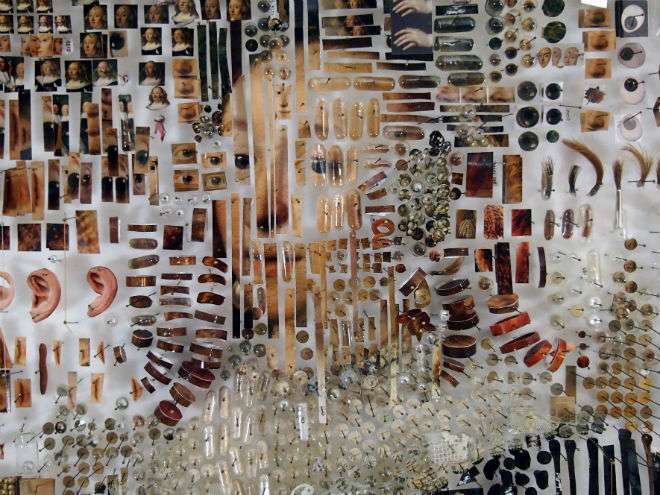

Last, but not least, our experience of time depends on our framework and perception. Time seems to drag along when we feel bored or anxious, and in contrast time flies away when we enjoy it. While, our understanding of time and temporal patterns often depends on the lens we visualize. Hence arises the The Peculiar Fragmented Portraiture of Michael Mapes as a great example on how the whole could be greater than the sum of its parts. The artist visualizes the temporal data through a series of works based on famous portraits from the 16th-17th centuries.
Featured Mosaics: Courtesy Of Michael Mapes
What else would you have liked to have seen in this article?
Have any other thoughts or questions about time ? Let us know in the comments below.
Got inspired by reading this article? You May Also Want To Read What Does the Future of Mosaic Art Look Like?
Don’t Forget to Subscribe to our Newsletter for Weekly Updates on Mosaic Art, Decor, Creativity and Much More!


 English
 French
 German
 Italian
 Portuguese
 Russian
 Spanish