Close
Try Your Luck
With Mozaico
With Mozaico

Try Your Luck
With Mozaico
With Mozaico
Email Already Subscribed

we ship worldwide

money back guarantee

exclusive
630.300.3942
What can we help you with?
Shipping & Taxes. FAQ.630.300.3942
What can we help you with?
How to install a mosaic.Get one-on-one expert advice from our lead designer to help you transform any area around your home or work.
Fill out the form below to submit your designer question.
Take a picture of a room in your home, a floor area or a table top that you would like to ask a question about - or simply anything you would like to make into mosaics.


Mosaic tiles work almost anywhere in a bathroom, but not every material suits every surface. Glass is bright and reflective, which makes it well suited to backsplashes, countertops and anywhere catching the light. Marble and natural stone are the most durable and the usual choice for floors and large wall panels. Metallic adds depth and contrast against the soft colours bathrooms usually default to.
The practical advantage is simple: mosaic is the one form of art that can live in or around a wet environment — a bathroom, a shower, a pool — and keep its colour and quality. Small pieces also mean more grout lines, which is what makes a mosaic floor less slippery than a large-format tile.
| Surface | What works | Why |
|---|---|---|
| Shower walls | Glass, marble, natural stone | Takes a full design or a single accent wall; handles constant water |
| Shower floor | Natural stone, marble | Many small pieces means many grout lines, which gives grip underfoot |
| Shower ceiling | Glass, marble | Tiling it stops steam condensing into mould on a painted ceiling |
| Niches and benches | Any | Small areas, so a contrasting or complementary design reads clearly |
| Bathroom floor | Natural stone, marble | Slip-resistant, easy to clean, and a mosaic rug defines a zone |
| Backsplash and countertop | Glass, marble | Glass is vibrant under bathroom lighting; marble reads traditional |
| Walls beyond the shower | Stone and glass combined | A moisture-proof alternative to wallpaper, with far less maintenance |
| Curved surfaces | Any | Small pieces follow curves and non-linear shapes that large tiles cannot |
The shower is where mosaic earns its place, because every surface in it is wet, and several of them are curved.
Inside a walk-in or doorless shower, a mosaic accent wall is the easiest way to give the room a focal point — the same role the wall above a hob plays in a kitchen.
It can be a pattern, or it can be a view. A dark, neutral corner becomes an airy one with a coastal cliff scene on the wall; a windowless shower gets a landscape that functions as the window it does not have. This is also where a custom piece earns its cost — a favourite photograph or a holiday vista worked in tile, so the view is one you chose rather than one the building gave you.
How far to take it is a judgement. Blending the mosaic's colours into the wall and floor treatment keeps a serene feel; a full-contrast design makes the shower the thing you notice first. Both are valid, but decide which before ordering.
Small recessed shelves and built-in benches are the natural place to show a different tile. Use a contrasting shade for a pop of colour, or stay within the same palette for something quieter. Letting a design run over the edge of a bench and onto the shower floor is a good trick — it ties the two surfaces together, and mosaic handles that transition because it bends around the curve.
If you are matching existing marble or tile, the mosaic can be made to your palette rather than chosen from stock.
The instinct is to tile walls and floor and stop. Tiling the ceiling does two things: it adds texture overhead and visually lifts the space, and it prevents mould. Steam rises, condenses on a painted ceiling, and mould follows. A tiled ceiling has nothing for it to grow on.
In a small bathroom, where steam is already a problem, this matters more than the aesthetics.
Mosaic is the standard choice for shower floors for a practical reason: the grout lines between small pieces give grip that a single large tile cannot, and the pieces follow the fall to the drain.



Outside the shower, mosaic on the floor does two jobs. It is slip-resistant, easy to clean and impervious to water. And a mosaic rug — a framed panel set into the floor — gives you the visual weight of a woven rug in a room where an actual rug is impractical.
That weight is the point. A mosaic rug breaks up a long stretch of plain tile, marks the traffic route between rooms, and defines an area without furniture: in front of a vanity, around a freestanding bath, at the threshold. Unlike a real rug it is flush with the floor, so there is nothing to trip on and nothing to dry out.
A border does the same more subtly — running the perimeter, or framing a plain field. Both sit happily against wood, stone and porcelain, which means a mosaic rug can be set into a floor you are keeping rather than replacing. The same designs work outdoors, if you want to carry something through to a terrace.


This is where most bathroom mosaic decisions are actually made, and there are only two strategies. Either the mosaic complements what is already in the room, or it deliberately contrasts with it. Both work. Doing neither is what produces a bathroom that feels busy.
Many bathrooms have very little colour outside the shower. A mosaic is the opportunity to pick up the tones already present — the wood of a vanity, the grey of a slate countertop, the warmth of a stucco wall — and reflect them back. A geometric marble floor that carries the colours of the cabinetry and the stone wall treatment grounds a room in a way that a contrasting floor never would.
At the finest level, this means matching the stone itself: choosing natural stones and marble whose veining and shading match the tile already on the walls, so an inset medallion looks original to the room rather than added to it.
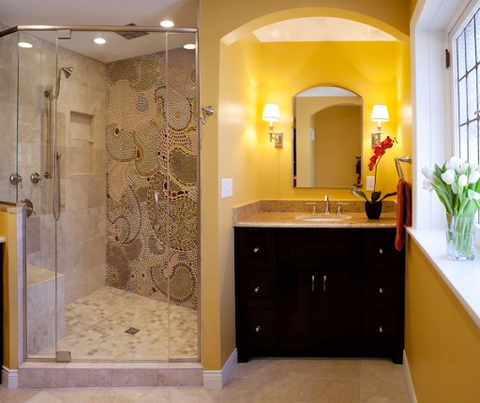
The opposite approach is a counterpoint. Intense reds in a floral design against a blue floor. A glass mosaic accent wall in a room of pale tile. Sunny yellow walls set against a dark cabinet and a patterned shower wall. The rule is to commit — a half-hearted contrast reads as a mismatch, a full one reads as deliberate.
If the room has an unusual feature, use it. A coved ceiling suggests a design that mirrors its curve. An arched ceiling and a stepped privacy wall ask for something with the same movement — floral bouquets rather than a grid. A round medallion inset into rectangular shower tiles echoes the curve of a shower bench. These are the installations that look considered rather than decorated.
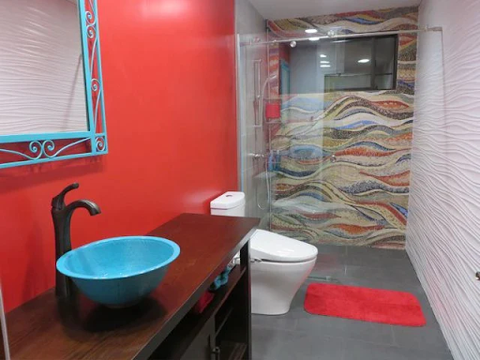
A long, narrow bathroom with a bold sink is a design problem; a complementary mosaic on the shower wall is what pulls it together instead of leaving it fighting itself.
Beyond the shower, mosaic is a direct replacement for wallpaper — including patterns that imitate wallpaper — with the difference that it is moisture-resistant and needs almost no maintenance. Combining natural stone with glass gives depth that a printed surface cannot.
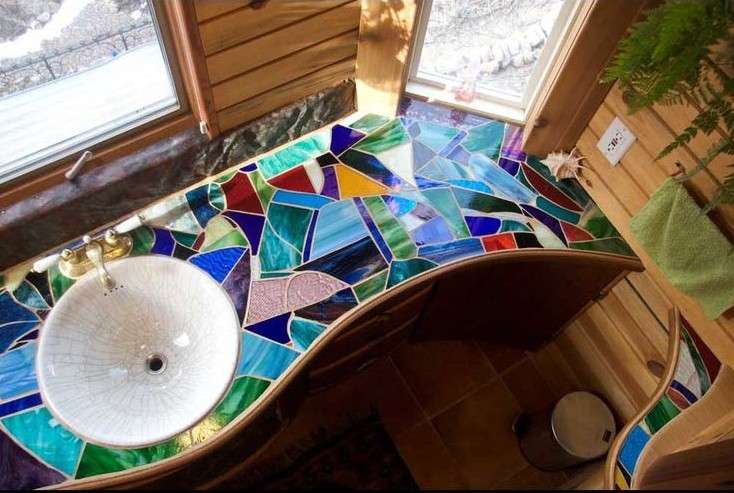
Around the basin, a mosaic backsplash is the smallest commitment in the room and often the most noticeable. A large motif built from small tiles brings scale to a bathroom of any size, and the same approach works on a countertop.



| Material | Character | Best for |
|---|---|---|
| Glass | Reflective, strong colour, changes with the light | Backsplashes, countertops, ceilings, anywhere lit |
| Marble | Traditional, the most durable, holds fine detail for figurative work and reproductions | Floors, large wall panels, anything meant to last |
| Natural stone | Warmer and more muted than glass | Floors, shower floors, walls |
| Metallic | Brushed aluminium or shimmering glass; dramatic | Accents and contrast against pale bathroom colours |
A working rule: pick one surface to carry the detail and keep the others quiet. An intricate floor wants a plain ceiling. A bold ceiling wants a restrained floor. Doing both competes with itself.
Colour runs the same way. Blues and greens — nautical palettes — are the common choice because they suit water, and they are strong enough to carry across floor, walls and ceiling together without becoming overwhelming the way a hot colour would.




Mosaic suits small bathrooms better than large ones, for three reasons that have nothing to do with looks: the floors are non-slip, the surfaces are easy to clean, and tiling the ceiling solves the steam problem that small rooms always have.
The visual argument is that pattern and texture give a small room something to look at, which makes it feel considered rather than cramped. And because the areas involved are small, it is a realistic budget choice — a niche, a backsplash or a single accent wall is a modest amount of tile.
Sealed mosaic in a bathroom needs very little. Wipe it down as you would any tile; the grout is what needs attention over time, not the tesserae. Natural stone and marble should be sealed, and resealed periodically, because grout is porous and a bathroom is permanently damp.
This is the main advantage over wallpaper or paint in a wet room: there is nothing to peel, and nothing for mould to take hold on.
A few directions worth considering, drawn from installations we have made.


Bathroom and pool mosaics · Marble mosaic art · Mosaic flooring · Custom mosaics · How to install a mosaic
Yes. Mosaic is designed for wet environments and keeps its colour and quality in them. The small pieces also mean more grout lines, which makes mosaic floors less slippery than large-format tiles.
Yes — on walls, floors, ceilings, niches and benches. It is one of the few materials that handles every surface in a shower, including curved ones.
Natural stone or marble. The grip comes from the number of grout lines between small pieces, and the pieces follow the fall of the floor towards the drain.
It is worth doing. Steam rises and condenses on a painted ceiling, which is where bathroom mould usually starts. A tiled ceiling removes the surface it grows on, and it makes the space feel taller.
Glass for anything lit — backsplashes, countertops, ceilings — because it reflects and the colour shifts with the light. Marble for floors, large panels and detailed figurative work, because it is more durable and holds finer detail.
Natural stone and marble should be sealed and resealed periodically. Grout is porous, and a bathroom stays damp, so the sealing protects the grout more than the tile.
It depends entirely on area. Mosaic is usually used on a niche, a backsplash, a border or one accent wall rather than the whole room, so the quantity involved is small — which is why it works as a budget option in small bathrooms.


2 comments
Love the custom tile!
I will definitely add a mosaic to my bath bench, looks wonderful!