Close
Try Your Luck
With Mozaico
With Mozaico

Try Your Luck
With Mozaico
With Mozaico
Email Already Subscribed

we ship worldwide

money back guarantee

exclusive

630.300.3942
What can we help you with?
Shipping & Taxes. FAQ.630.300.3942
What can we help you with?
How to install a mosaic.Get one-on-one expert advice from our lead designer to help you transform any area around your home or work.
Fill out the form below to submit your designer question.
Take a picture of a room in your home, a floor area or a table top that you would like to ask a question about - or simply anything you would like to make into mosaics.

Cover Photo: Dino Maccini
“Just as one can compose colors, or forms, so one can compose motions.”
Looking for new ways to understand mosaics?
Have you yet explored the enthralling movement in kinetic mosaic artworks?
In visual art, the term kinetic art, derived from the Greek word “kinesis”, refers to works that incorporate an apparent movement. Thus, for instance, it may include mosaic art, defined by its unique aspect of integrating motion into its splendor and purpose. Unlike traditional mosaic art, kinetic mosaics are created by a combination of both, accurate details and natural flaws.
In this article you will discover what kinetic art is really about and how to understand this art movement!

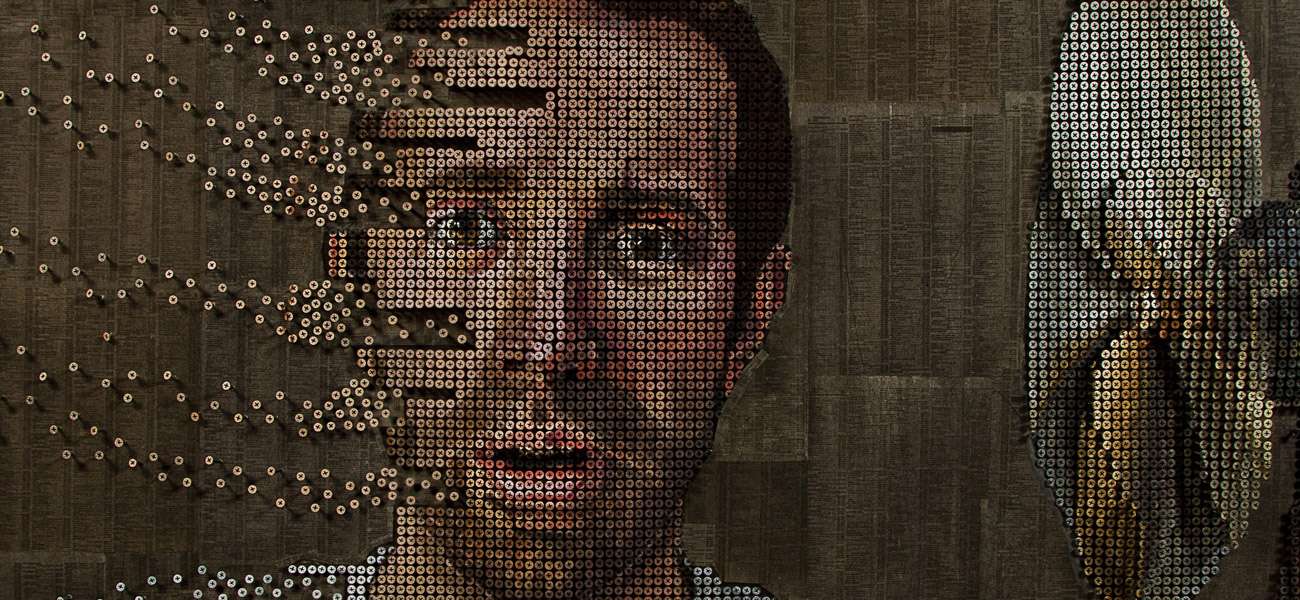
Screw Kinetic Mosaics | Courtesy of Andrew Myers
Kinetic art is usually divided into two major sections:
Most Kinetic artists prefer to fuse their work with the forces of nature, i.e. wind, solar power, gravity or magnetism to power their works.
In the early days of Kineticism, most artworks were influenced by geometric compositions. The interest in this art form and concept dates back to 1913 during the Dada and Constructivist movements. Although its history is unfathomable, it wasn’t established as a major artistic movement until the 1950s.

Kineticism has been around since the early 20th century but it didn’t become a modern art form until a few artists, including Naum Gabo and Laszlo Moholy-Nagy initiated the use of electric machinery in their 3D artworks.
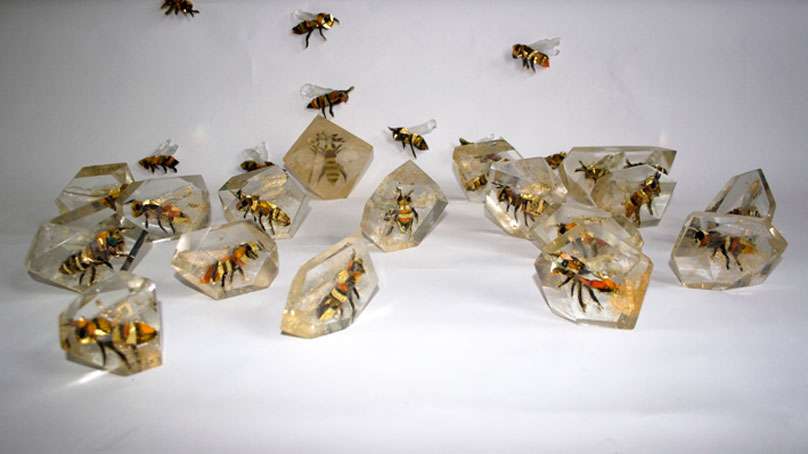
Goldrush – Mosaic Crystal Bees | Courtesy of Ruth Minola Scheibler

The main idea of kineticism is revive the tradition of Constructivism, or Constructive art, the challenge is to make the constructive movement obvious to the eyes of the beholder. Therefore, using bright colors was swapped by dark tiles to create clear-cut shadows and motion. In order to create a kinetic mosaic artwork, defined shapes has to be created within a three-dimensional horizon.

Sand Ionic – Courtesy of Thomas Denker
Today, the Kinetic art movement seems less a pressing influence for artists than a resource for ideas.
Major collections of Kinetic art can be seen in some of the best art museums in the world, including:
• Museum of Fine Arts, Houston
• Fine Art Museums of San Francisco
• Whitney Museum of American Art, New York
• Jean Tinguely Museum, Basel
• George Pompidou Centre, Paris (Musee National d’Art Moderne)

This mosaic installation is a very good example of a mosaic which creates a kinetic illusion. The mosaic illustrates a wave motion in a cohesive structure, creating the aforementioned illusion leaving us with the impression of the up-welling movement in the ocean.

Mosaic Courtesy: Mia Tavonatti
Aqua Forte, created by Mia Tavonatti for the 1st International Symposium for Contemporary Mosaics in Clauiano, Italy
What other art movements would you like to talk more about?
Share your thoughts with us in the comment box below!
Got inspired by reading this article?
You May Also Want To Read Impressionist Mosaics: Portraying a Perceptual Impression
Don’t Forget to Subscribe to our Newsletter for Weekly Updates on Mosaic Art, Decor, Creativity and Much More!


 English
 French
 German
 Italian
 Portuguese
 Russian
 Spanish
1 comment
شكرا لهذه الاضاءات المهمة على فن الفسيفساء التشكيلية ، كفن قابل للتطور ومواكبة باقي الفنون العصرية ..