Close
Try Your Luck
With Mozaico
With Mozaico

Try Your Luck
With Mozaico
With Mozaico
Email Already Subscribed

we ship worldwide

money back guarantee

exclusive
630.300.3942
What can we help you with?
Shipping & Taxes. FAQ.630.300.3942
What can we help you with?
How to install a mosaic.Get one-on-one expert advice from our lead designer to help you transform any area around your home or work.
Fill out the form below to submit your designer question.
Take a picture of a room in your home, a floor area or a table top that you would like to ask a question about - or simply anything you would like to make into mosaics.

The Roman Empire gave birth to some of the most iconic mosaic art in the history of tile art.
In Roman times, mosaic artworks were commonly used to decorate home floors and walls, and they were considered some of the most prestigious decorations of their time.
Although these decorations were very common back then, one who possesses such valuable ornaments was depicted as both elegant and wealthy.
A vastly large number of names recorded back then were actually belonging to greek artists, indicating that most of the mosaic floor and wall artworks were actually crafted by Greek artists; ones who do not possess Roman roots.
Their high-quality work was dispursed all across the Roman Empire, proving that their skills were well appreciated and respected.
There were two methods used in creating Roman mosaic art:
The Roman mosaics that were crafted using the Opus vermiculatum were mostly belonging to wealthy people or ones who were powerful. A number of these mosaics were found in Pompeii.

This ancient mosaic artwork was discovered in the early twentieth century in the ruins of a seaside Roman villa. Immediately after excavation, the Italian archeologist Salvatore Aurigemm — who discovered this mosaic floor art — categorized this piece of Roman heritage as a masterpiece of mosaic art.
The borders of this mosaic artwork are carefully crafted using the Opus tessellatum method, and the rest was mostly done using an uncommon third method called “Opus sectile”.
This mosaic depicts three different Roman activities:


This floor mosaic has a gigantic area of 2.72 x 5.13 meters. It depicts the battle between the armies of Alexander the Great and Darius III — the last Achaemenid King of Kings of Persia.
Alexander and Darius are the main elements of this mosaic artwork, and they’re the most noticeable ones as well.
Alexander is depicted with a large Roman nose, and with large worried eyes. On his chest, we see a breastplate with the head of the all-mighty Medusa.
This mosaic is assembled using approximately half a million tiny colored tesserae tiles, following the method of opus vermiculatum. This professionally constructed piece of mosaic floor art is done with remarkable precision and accuracy; indicating that it was commissioned by a wealthy character or group.
One unique thing regarding the assembly of this mosaic is that it’s done using only colored tiles found in nature. This by itself shows the level of dedication and hard work presented by artists back then.

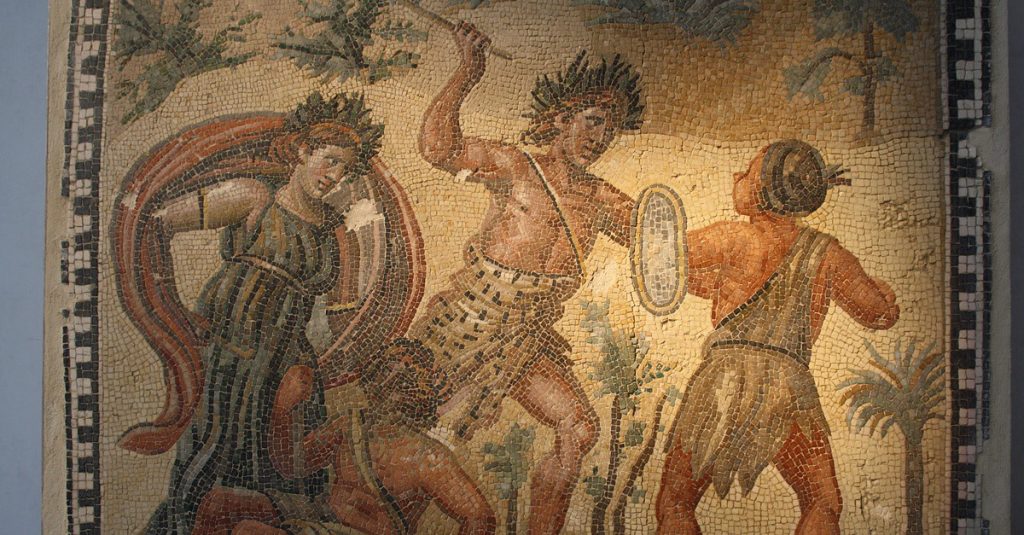
This mosaic artwork depicts Dionysus — the god of grape-harvest and wine — fighting a group of Indian soldiers. The reason for this brutal combat is Dionysus’s desire to accompany his fellow gods on Mount Olympus.
Zeus — God of thunder, and father to all gods — ordered Dionysus to initiate and participate in this war with the Indians if he wished to achieve his desire.
This mosaic is made with impeccable accuracy and attention to detail. From the muscle structure to all facial expressions presented in this mosaic artwork, the artists involved in it showed nothing less than pure professionalism and skill.
Similar to the mosaic of Alexander the Great, all the colored tiles ad collected from natural resources. Even in the most complex situations, artists used to always find a way to achieve perfect results.
The Roman Empire is filled with various forms of art, and we’re lucky enough to witness their traditions persist to this day.
Mosaic art captures a scene, immortalizes it, and carries it through history.
If you’re interested in buying or seeing some more mosaic artworks, then head to our website for the largest selection of mosaic art at your disposal.
P.S. We ship globally!


2 comments
Thank you for your comment! We’re thrilled to hear that our blog could shed some light on the incredible mosaic art in Rome. Italy has such a rich cultural history, and there’s always something new to discover. If you have any more insights or experiences to share, we’d love to hear them!
I’ve lived in Italy my whole life and i didn’t know that much about mosaic art in Rome.