Close
Try Your Luck
With Mozaico
With Mozaico

Try Your Luck
With Mozaico
With Mozaico
Email Already Subscribed

we ship worldwide

money back guarantee

exclusive
630.300.3942
What can we help you with?
Shipping & Taxes. FAQ.630.300.3942
What can we help you with?
How to install a mosaic.Get one-on-one expert advice from our lead designer to help you transform any area around your home or work.
Fill out the form below to submit your designer question.
Take a picture of a room in your home, a floor area or a table top that you would like to ask a question about - or simply anything you would like to make into mosaics.


A garden changes every month of the year, and for several of those months it has very little colour in it. Mosaic is the one decorative surface that does not care — it holds its colour through frost and full sun, it is unbothered by rain, and in February it looks exactly as it did in July.
That is the real argument for mosaic outdoors, and it is why it works in places where a painted or printed surface would not last two seasons. Below are eighteen ideas organised by where they go, and then the part most garden articles leave out: what actually survives outside, and what fails.
| Feature | Why it works | Watch for |
|---|---|---|
| Walls and fences | Vertical surface, nothing walked on, biggest visual return | Fixing into render or masonry, not timber that moves |
| Paths and stepping stones | Interest underfoot where there is otherwise plain concrete | Slip resistance — this is the one that matters |
| Water features | Glass comes alive wet; mosaic can imply water with none present | Constant wet/dry cycling needs the right adhesive |
| Pools | The traditional home of mosaic; survives chemicals and immersion | Specify pool-grade materials, not general outdoor |
| Planters and raised beds | Small areas, big effect, cheap to try | Soil moisture behind the substrate |
| Seating and tables | Hard-wearing surface that improves with use | Grout lines on a dining surface collect debris |
The highest-impact place to start, because a garden wall is usually the largest blank surface you own and nothing stands on it.


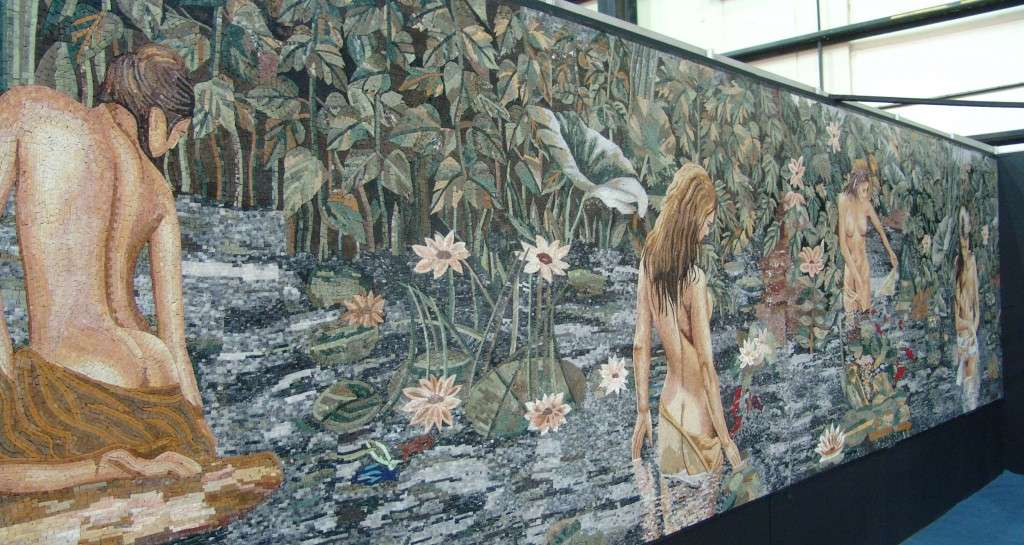

1. A single large panel. One substantial piece on an otherwise plain wall does more than several small ones scattered about. A tranquil subject — figures, water, foliage — sits comfortably against planting, and the scale gives a sense of perspective to a small garden.
2. Panels set into a boundary wall. Instead of hanging work on the wall, build it in. Panels recessed into the low retaining walls either side of an entrance read as architecture rather than decoration, and they are protected from knocks.
3. Mosaic on a building exterior. A panel mounted high on a house wall or gable catches light all day and is visible from the whole garden. This is the one idea that genuinely changes how a building looks rather than how a garden is decorated.
4. Wrap the tiles over an edge. Carrying mosaic up a wall and over its coping, or around a corner, removes the sense of a framed picture and makes the surface itself the artwork. It is also the trick that creates the illusion of water spilling over a lip.
5. A stucco or rendered wall as the canvas. Smooth render is the easiest substrate to work on and takes free-form, organic designs well — a wave of colour defining a doorway rather than a rectangle hung on a wall.

6. Accent an existing path rather than replacing it. A loose patchwork of field tiles worked into plain concrete along the curves of a path costs a fraction of a full mosaic walkway and achieves most of the effect. Match the tile colours to what is planted alongside.
7. Carry the same tiles onto adjacent features. Pulling the path's tiles up onto pond edges and raised beds is what makes a garden read as designed rather than decorated in patches.
8. Mosaic pads over water. Where a path crosses a pool or rill, patterned pads reading as stepping stones turn a functional crossing into the focal point.
9. A mosaic rug. Coloured stones laid to mimic an oriental carpet, complete with border and fringe, under a seating area in a shaded corner. Reds and golds do something useful in shade that planting cannot.

10. A waterfall that needs no water. The best idea in this list. An upturned ceramic pot as the source, with mosaic tiles cascading down a dry stone wall into a mosaic pool below. Run it with a recirculating pump or leave it dry — it reads as water either way, and it looks the same in January.
11. A koi panel instead of a koi pond. Where the ground will not take a pond, a detailed koi mosaic on a patio or wall gives the same thing without the filtration, the herons or the maintenance. This is trompe l'oeil doing real work.
12. Three-dimensional forms. Mosaic is better than flat tile at wrapping irregular shapes, so a mosaicked boulder or curved form suggesting a pool extends the idea of water into parts of a garden that have none.


13. A floor medallion. A single medallion on the pool floor, seen through moving water, is the most dramatic use of mosaic in any garden. Water magnifies and animates it in a way no dry surface can.
14. A waterline band. The cheaper, more common option: a decorative border at the waterline, optionally carried across the surround. Glass is worth the money here — it shifts and glitters as the water moves, which stone does not.

15. Tile a plain planter. The cheapest way to try mosaic outdoors. A cement building block faced in mosaic becomes a flower box worth looking at, and a border design suits the proportions better than a picture.
16. Match the tile to the planting. In a succulent or cactus bed, glass tiles chosen against the blue-green of agaves make the bed read as one composition. Scatter matching glass pebbles through the gravel and the effect carries across the whole area.
17. Raise one piece on a stand. Mosaic at ground level disappears once planting fills out in summer. Elevating one piece keeps it visible all season, and the difference in levels is itself worth having.


18. A mosaic table top. The most practical item here. It is weatherproof, it cannot fade, and unlike most garden furniture it looks better for being outside. A medallion design suits a round top, and a glass border lifts a plain one.
Benches take the same treatment, though grout lines on a seat are worth thinking about — keep them narrow and flush.
Three approaches, and the choice matters more outdoors than indoors because the planting changes colour through the year and the mosaic does not.


Complementary — colours opposite on the wheel, blue against orange, purple against yellow. Vivid, and it draws the eye to a specific spot. Use it where you want a focal point.
Monochromatic — shades of a single colour. Calmer and more cohesive, and it ages better next to planting that is constantly changing. The safest choice for a large area.
Natural tones — browns, greens, earthy reds. The mosaic blends into the landscape rather than sitting on top of it, which suits a rustic or informal garden and looks right in winter when the planting has gone.
One practical note: pick colours against the garden in winter, not in June. A scheme chosen to complement full summer planting can look stranded for five months of the year, whereas one chosen against bare soil and evergreen structure works in both.
This is the part the inspiration photos never cover, and it is what separates a mosaic that lasts twenty years from one that spalls off the wall after two winters.

Glass and ceramic are both weather-resistant and are the usual choice. Glass is lighter, more vivid and better in and around water. Marble and natural stone are the most durable of all and hold fine detail, at the cost of weight — which matters on a wall fixing.
The failure point is almost never the tile. It is what is behind it.
Anything walked on must be smooth and flush. No proud edges, no jagged fragments, nothing that catches a toe. On a path or stepping stone, choose tiles with some texture rather than a high polish — a glazed surface that is fine on a wall becomes genuinely dangerous wet and underfoot.
Around a pool the same applies with more force, which is why pool surrounds use specified non-slip material and the decorative glass stays at the waterline and below.
Very little, which is the point. Wash it down when it needs it. Once a season, check for loose tesserae and re-fix them before water gets behind and takes their neighbours with them. Damage in mosaic is local — you lose a few pieces, not the picture — and that is the whole reason these surfaces survive outdoors in the first place.
Mosaic is also the only art form that genuinely belongs in a wet or exposed place; for how that works across materials, see our guide to mosaic art versus tile art.

Mosaic wall art · Pool and bath mosaics · Mosaic flooring · Flower and tree mosaics · Custom mosaics
Yes, and it is one of the few decorative surfaces that genuinely suits it. Glass, ceramic and stone tesserae do not fade, and mosaic withstands rain, frost and sun. What matters is using outdoor-grade adhesive and sealant and fixing to a stable substrate.
Glass for water features and pools, because it stays vivid and reacts to light. Marble and natural stone for the most durable wall and floor work. Ceramic sits between the two and offers the widest colour range.
It will if it is installed for it. Freeze-thaw damage comes from water sitting in joints or behind the tile, so fully filled joints, outdoor-grade adhesive and periodic resealing matter more than the choice of tesserae.
They can be if the wrong tile is used. On anything walked on, choose textured rather than highly glazed surfaces, keep everything flush with no proud edges, and avoid sharp fragments entirely.
Not directly. Timber moves as it takes up and loses moisture, which cracks a rigid mosaic. Mount the mosaic on a board and fix the board to the fence, or use a masonry or rendered wall instead.
Choose against the garden in winter rather than in summer. Complementary colours create a focal point, a monochromatic scheme stays calm across a large area, and natural earthy tones blend into the landscape year round.
Washing down as needed, and a seasonal check for loose tesserae so they can be re-fixed before water gets behind them. Resealing is periodic rather than one-off, and more frequent on horizontal surfaces.
Start with a planter or a table top — both are small, cheap to try and highly visible. A single wall panel is the next step up and gives the biggest change for the money.


2 comments
Thank you for your comment! We’re also in love with the artistry and imagination that comes with creating beautiful mosaic artwork!
Absolutely LOVE the art/imagination of these mosaics artists! Beautiful! They have inspired me to have a new hobby after being retired 1 1/2 years and more time on my hands.