Close
Try Your Luck
With Mozaico
With Mozaico

Try Your Luck
With Mozaico
With Mozaico
Email Already Subscribed

we ship worldwide

money back guarantee

exclusive
630.300.3942
What can we help you with?
Shipping & Taxes. FAQ.630.300.3942
What can we help you with?
How to install a mosaic.Get one-on-one expert advice from our lead designer to help you transform any area around your home or work.
Fill out the form below to submit your designer question.
Take a picture of a room in your home, a floor area or a table top that you would like to ask a question about - or simply anything you would like to make into mosaics.


Antoni Gaudí did not invent mosaic, and he did not invent breaking tiles. What he did was make the broken tile a structural idea rather than a decorative one — a surface that could wrap a curve no flat tile would ever sit on.
That technique is called trencadís, and it is why a Gaudí building looks the way it does. This guide covers how it works, where to see it, and the artists who have carried it on from Havana to Chandigarh.
Trencadís comes from the Catalan trencar, to break. It is mosaic made from irregular fragments of ceramic, glass or marble rather than from cut tesserae of a uniform size — and the irregularity is the point.

A conventional mosaic of square tesserae wants a flat plane. Gaudí did not build flat planes. His surfaces undulate, bulge and twist, and a broken fragment will follow that geometry in a way a square will not, because every piece can sit at its own angle. The join lines stop being a grid and become something closer to crazed glaze.
Three things follow from that:
If you want the wider technical context — direct versus indirect setting, and where trencadís sits among them — see our guide to mosaic techniques.
The most concentrated display of trencadís anywhere, and a commercial failure.
Count Eusebi Güell, Gaudí's patron for most of his career, bought a hillside outside Barcelona and commissioned a gated housing estate for wealthy buyers. Work ran from 1900 to 1914. Almost nobody bought. Two houses were built, the scheme was abandoned, and the site opened as a public park in 1926 — which is the only reason it is possible to walk through it today.
The main terrace is edged by a single continuous bench that snakes around its whole perimeter. It is the largest trencadís surface Gaudí ever made, assembled from broken ceramic in no repeating scheme — whites, blues, yellows and fragments of patterned tile that were clearly something else first.
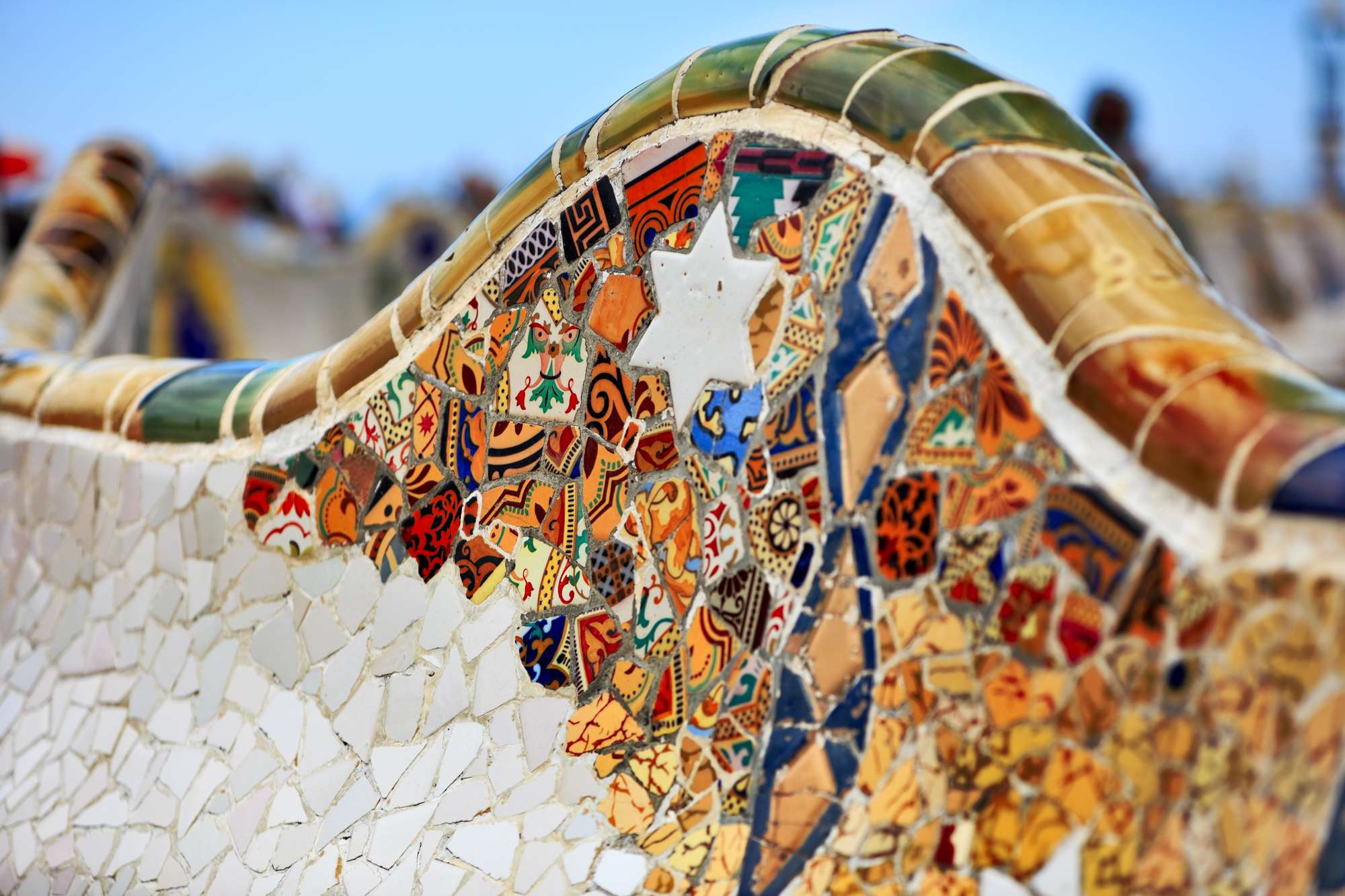


Two things are worth noticing in person. The bench is moulded to the human back, reportedly by having a workman sit in wet clay, so a structure that looks purely sculptural is in fact ergonomic. And the terrace doubles as a water system: rain drains through the surface, filters down the columns of the hall beneath, and collects in a cistern.
The creature on the entrance staircase is the single most photographed mosaic in the world. Locals call it el drac, the dragon, though it is more usually described as a salamander.


It is built from broken ceramic in yellows, greens and reds, and it functions as a fountain. The tradition is to touch it for luck, which is why the trencadís on its snout and front legs is visibly more worn than the rest.
Beneath the terrace, eighty-six Doric columns hold up the bench above. The ceiling between them is plain white trencadís, interrupted by large circular medallions.


The roundels are the finest mosaic work in the park, made with collaborator Josep Maria Jujol from broken bottles, cups, plates and glass. Look closely and you can identify what the fragments used to be. Most visitors walk through the hall without looking up, which is the usual mistake here.
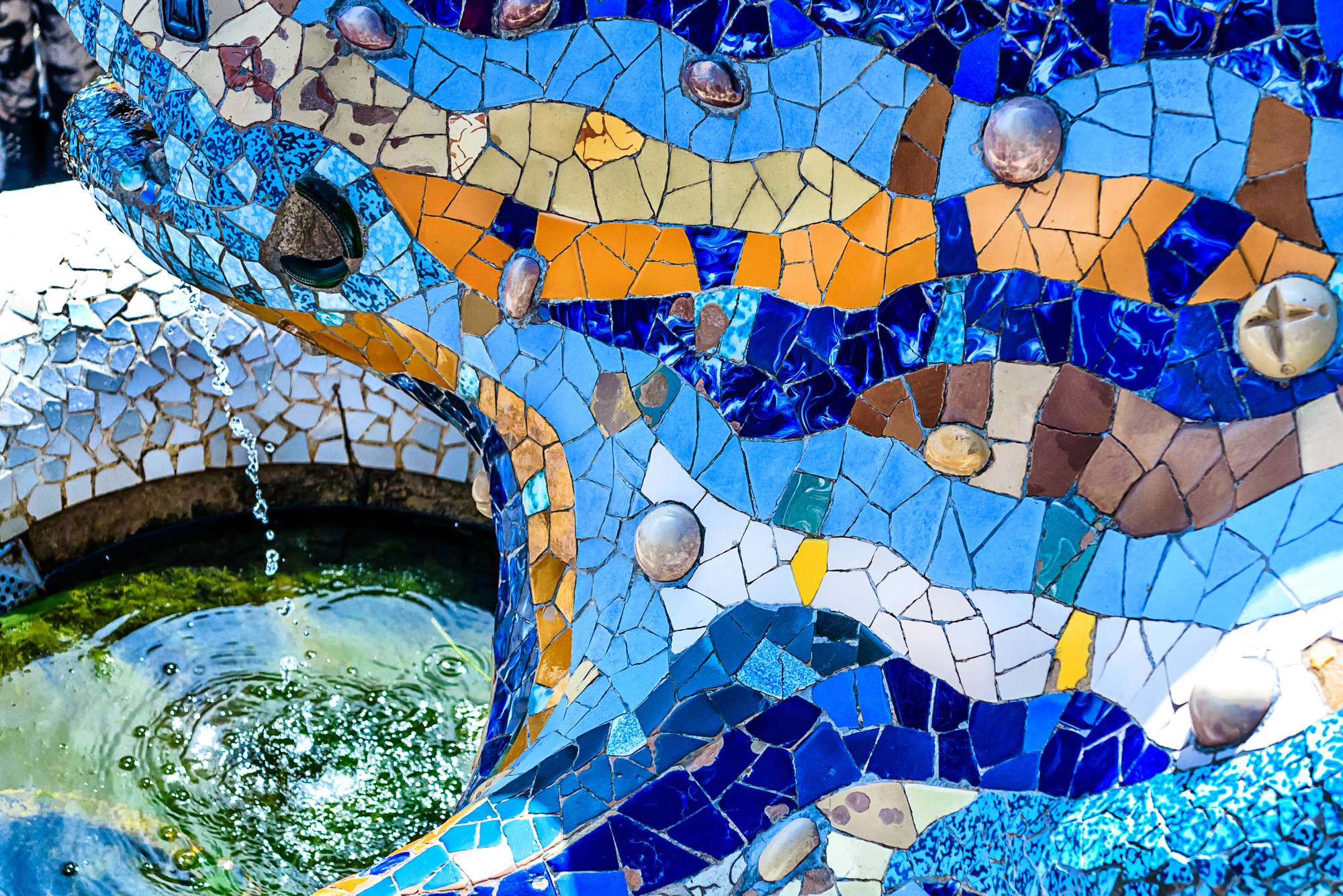

The two gatehouse pavilions at the entrance carry the same treatment on their roofs and spires, and the terrace gives the view over Barcelona that put the park on every itinerary.

Begun in 1882 as a conventional Neo-Gothic church. Gaudí took over in 1883 and redesigned it completely, and he worked on it until his death in 1926 — the last years exclusively. It is still unfinished.
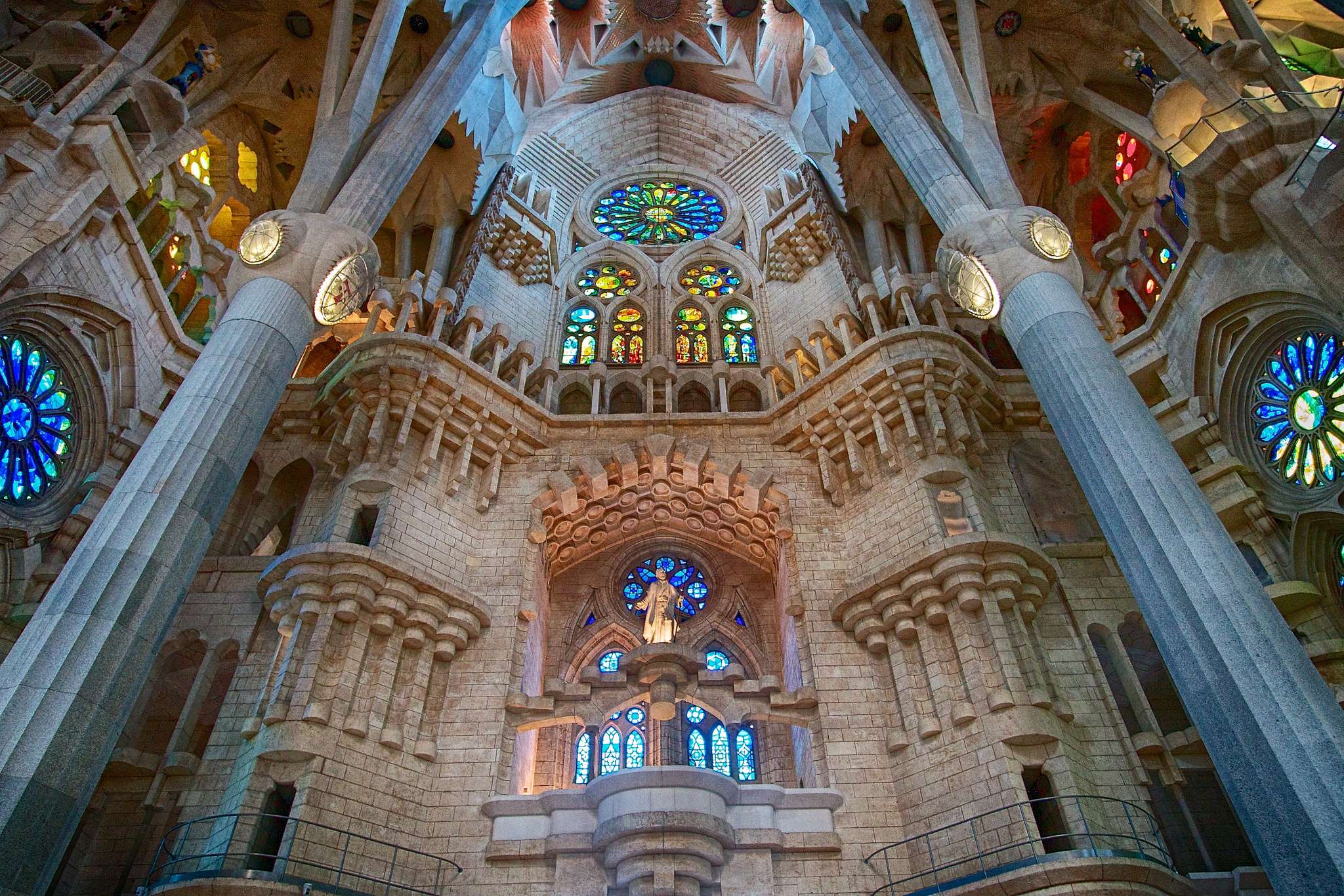

The plan calls for eighteen towers: twelve for the Apostles, four for the Evangelists, one for the Virgin Mary and the tallest for Jesus Christ. That central tower is designed to reach 172.5 metres, which will make the Sagrada Família the tallest church in the world. Its completion has been targeted for 2026, the centenary of Gaudí's death.
The bell towers are capped with mosaic finials, which is why the building reads as colourful from a distance even though the stone is not.

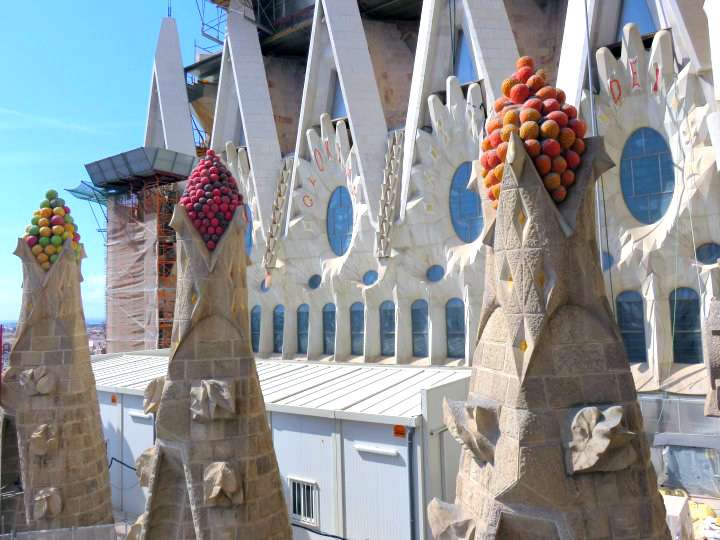


The most charming detail is on the naves: mosaic fruit, representing the seasons, set at the tops of the pinnacles. Wheat and grapes appear too, standing for the sacrament. They are far enough up that most people never see them without a lens.

Each facade takes a different subject and a markedly different style, because each was built in a different era by different hands.
| Facade | Subject | Character |
|---|---|---|
| Nativity | The birth of Christ | Built largely in Gaudí's lifetime; dense, organic, almost overgrown |
| Passion | The crucifixion | Stark and angular by deliberate contrast |
| Glory | The path to God | The largest, and still under construction |


The interior is the part photographs undersell. The columns branch like trees to carry the vault, and the stained glass is graded by colour — cool blues and greens on one side, reds and oranges on the other — so the light inside changes temperature as the day moves across the building.


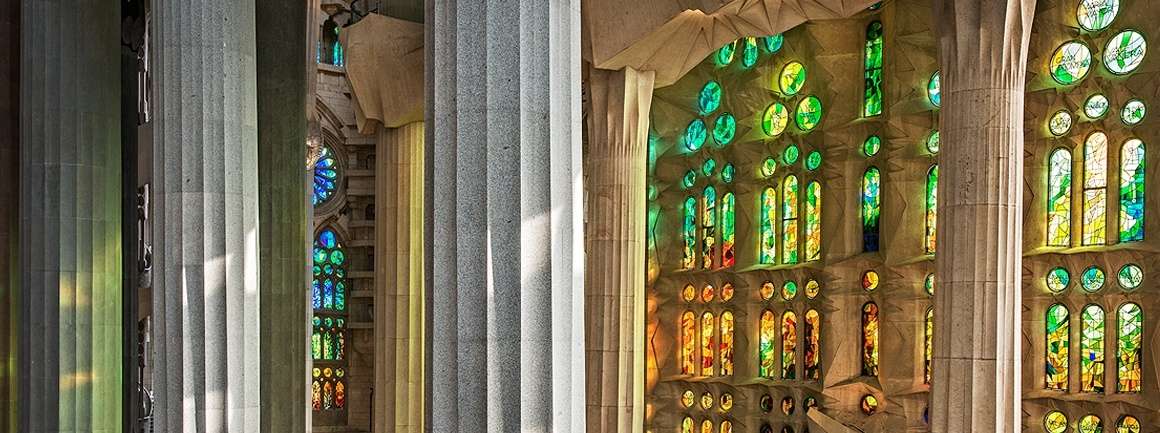
Construction has been funded by private donation throughout, which is the main reason it has taken so long. The Spanish Civil War interrupted it and destroyed many of Gaudí's models and drawings, leaving later architects to reconstruct his intentions.
Seven Gaudí properties are inscribed as UNESCO World Heritage. These are the ones where mosaic does real work.
| Building | Where | What to look for |
|---|---|---|
| Casa Batlló | Barcelona | The rippling facade and the dragon's back along the roofline |
| La Pedrera (Casa Milà) | Barcelona | The rooftop chimneys — the mosaic is all above your head |
| Casa Vicens | Barcelona | His first house commission; tile inside and out |
| El Capricho | Comillas, Cantabria | Sunflower tiles and a minaret-like tower |
| Güell Pavilion | Barcelona | Mudejar-inspired tilework and the dome over the lunging ring |
| Church of Sant Pacià | Barcelona | Marble mosaic floors from his student years |
| Colònia Güell | Santa Coloma de Cervelló | Mosaic against raw basalt in an unfinished crypt |
A remodel rather than a new build, and the best short introduction to what Gaudí did with colour. The facade is faced in fragments of glass and ceramic that shift from blue to green to gold as they rise, so the whole wall appears to ripple like water. Locals call it the Casa dels ossos, the House of Bones, for the skeletal balconies.
The roofline is a tribute to Saint George: the tiled ridge is the back of the dragon he killed, and the turret is the lance. Once you have seen it you cannot unsee it.
Its real name is Casa Milà; La Pedrera means the quarry, which is what Barcelona called it when it went up because the stone facade looks excavated rather than built. It was controversial in 1912 and is a UNESCO site now.


The mosaic is entirely on the roof. Gaudí took the functional clutter of a roofline — chimneys, vents, stairwell exits — and turned each one into a sculpture, several of them clad in trencadís. The helmeted chimney forms are often claimed as an influence on later film design, and whether or not that is true, the terrace is one of the strangest places in the city.
Gaudí's first house commission, built when he was in his early thirties, in the Neo-Mudejar style — the Islamic-influenced idiom then fashionable in Spain. It is a useful corrective to the idea that his style arrived fully formed: the tile here is laid in flat geometric bands, nothing like the broken fragments of his later work.


It opened as a museum in 2017 after a long restoration, so the interiors can now be seen.
One of very few Gaudí buildings outside Catalonia — a summer house at Comillas on the north coast, built for Máximo Díaz de Quijano when Gaudí was thirty-one. The name refers to the capriccio, the freely structured musical form, which suits it.


The palette is the surprise: green against the oranges and reds, picking up the hills around it rather than the Mediterranean light he usually worked in. The motif throughout is the sunflower, in glazed ceramic, and the tower reads as a minaret.
A remodel of the Güell estate at Sarrià, now inside modern Barcelona. What survives is mostly to do with the count's horses: gates, walls, and a dome over the lunging ring where they were trained, richly worked in small tile and glass mosaic. Ventilators across the property get the same treatment.


The design is Mudejar-inspired, like Casa Vicens, and the site now houses the Royal Gaudí Chair of the Barcelona Polytechnic University.
The earliest work on this list and the least visited. As a student of Joan Torras i Guardiola, Gaudí was given the mosaic floors of this church in Sant Andreu del Palomar. He is thought to have taken his cue from the Romanesque church of Sant Pau del Camp.


It is off the standard Gaudí circuit entirely, which is the argument for going: you can see what he was doing before he was Gaudí.
A church for the workers at Güell's textile colony, of which only the crypt was ever built. Gaudí set mosaic directly against rough basaltic stone, and the contrast between the two is the whole effect. The structural ideas he tested here — the leaning columns, the branching supports — went straight into the Sagrada Família.
Gaudí's influence did not stay in Barcelona. These five took the method somewhere else.
The Spanish architect and engineer behind the Milwaukee Art Museum and the World Trade Center Transportation Hub. The structural resemblance to Gaudí is obvious — buildings that look like organisms — but the mosaic debt is easy to miss until you get close.


At the City of Arts and Sciences in Valencia, trencadís emerges from what looks at distance like plain white sculpture. The Montjuïc Communications Tower, built for the 1992 Barcelona Olympics and 136 metres tall, has an all-white mosaic base under a decidedly futuristic mast.
The most Gaudí-like project on earth, and it is in Cuba. Fuster visited Parc Güell, went home to the Jaimanitas neighbourhood of Havana in the 1970s and started covering his own house in mosaic.


His neighbours asked him to do theirs. He did. The result — Fusterlandia — is now hundreds of houses, walls, benches and rooftops in broken ceramic across a whole district. It is the one case where the community scale of Park Güell's original ambition actually happened.
Working in Puerto Vallarta, Mexico, in local tile, glass, mirror and reclaimed material. Her tile park is built through community workshops, so the people who live around the work helped make it — which is closer to how Gaudí's own crews operated than most gallery mosaic is.


In Guizhou province, China, Song Peilun has spent decades building Yelang Valley — a sculpture park of stone and mosaic figures drawn from the mythology of the ancient Yelang kingdom, made largely from local material.


Like Gaudí's, the structures are deliberately not finished to a commercial standard, and the park has never been run as a commercial attraction.
The outsider-art case. A road inspector in Chandigarh, India, Nek Chand began building a sculpture garden from industrial and domestic waste — broken bangles, tiles, crockery, electrical fittings — on government land, in secret, at night.
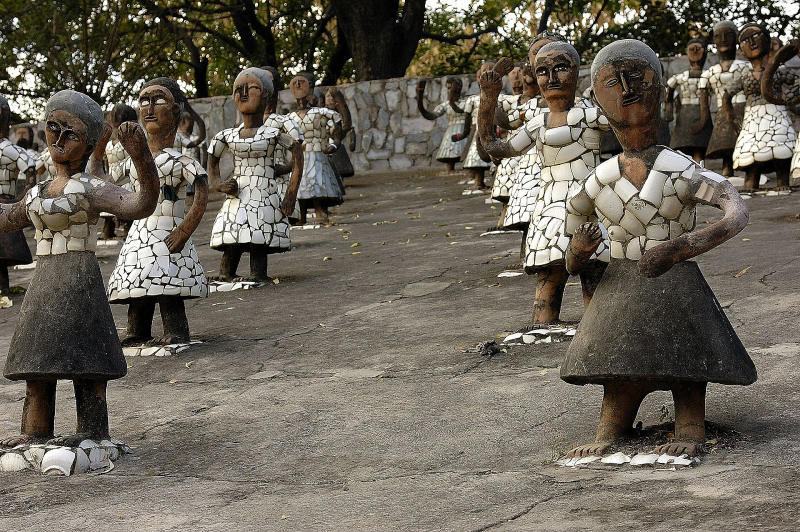
It was discovered by the authorities in 1975, by which point it was too large and too loved to demolish. The Rock Garden is now one of India's most visited sites. The material logic is exactly Gaudí's: whatever hard, coloured waste is available, applied by the handful.
The look translates domestically better than most architectural styles, because its logic is small pieces and strong colour rather than scale. Geometric medallions echo the Sant Pacià floors; fruit and organic motifs pick up the Sagrada Família pinnacles; a curved garden bench or a planter is the nearest thing to Park Güell you can own.


Geometric mosaic designs · Mosaic patterns · Mosaic wall art · Custom mosaics · The most famous mosaic artists
Mosaic made from irregular broken fragments of ceramic, glass or marble rather than uniform cut tesserae. The name comes from the Catalan trencar, to break. Because every fragment can sit at its own angle, the technique covers curved and organic surfaces that regular tile cannot.
Three reasons: broken pieces follow curved surfaces, they go on far faster than individually cut tesserae, and they can be made from offcuts and factory waste. His biographers trace the habit to a workshop visit where he lost patience with the pace of conventional mosaic work.
Park Güell, for density — the serpentine bench, the salamander and the medallions in the Hypostyle Hall ceiling are all in one place. For variety, the rooftop of La Pedrera and the facade of Casa Batlló.
A trencadís salamander on the entrance staircase, known locally as el drac, the dragon. It works as a fountain, and touching it is said to bring luck.
The park is public, but the Monumental Zone containing the bench, the staircase and the Hypostyle Hall is ticketed and entry times are limited, so it is worth booking ahead.
Construction began in 1882 and continues. The central Tower of Jesus Christ, designed to reach 172.5 metres, has been targeted for completion in 2026, the centenary of Gaudí's death; the Glory facade will follow.
Seven, inscribed as the Works of Antoni Gaudí, including Park Güell, Casa Batlló, Casa Milà, Casa Vicens and parts of the Sagrada Família.
Yes, and it suits curved and outdoor surfaces particularly well — garden benches, planters, pool surrounds and feature walls — for the same reasons it suited Gaudí's architecture.


