Close
Try Your Luck
With Mozaico
With Mozaico

Try Your Luck
With Mozaico
With Mozaico
Email Already Subscribed

we ship worldwide

money back guarantee

exclusive
630.300.3942
What can we help you with?
Shipping & Taxes. FAQ.630.300.3942
What can we help you with?
How to install a mosaic.Get one-on-one expert advice from our lead designer to help you transform any area around your home or work.
Fill out the form below to submit your designer question.
Take a picture of a room in your home, a floor area or a table top that you would like to ask a question about - or simply anything you would like to make into mosaics.

In Ukraine, mosaic art and daily life have been closely linked since early times - as far back as the 2nd century BC. Kyiv’s 16th century Saint Sophia Cathedral is a UNESCO World Heritage site, and its Byzantine style is a masterpiece of early church architecture. However, more recent mosaic art, from the Soviet era forward, has become a staple of Ukraine public areas.
Tragically, these installations have been damaged and destroyed since the beginning of the war. As buildings have been shelled, exterior walls have fallen - along with their mosaic treasures. In London, a poignant digital art exhibition both celebrated and memorialized some of the most famous pieces.
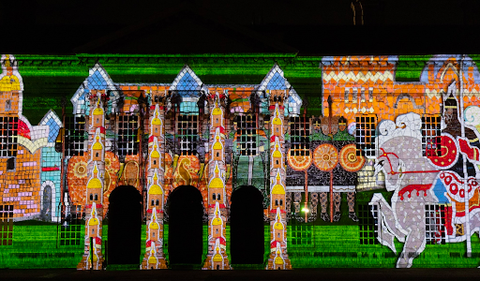
Image source British Council
Discover Ukraine: Bits Destroyed was produced by the British Council and the Ukrainian Institute in London. Part of the UK/Ukraine Season of Culture, the audio-visual installation recreated 56 mosaics from the heyday of these decorative mosaic wall art pieces.

Creating monumental mosaic pieces was part of a 20th century phenomenon - reaching its peak between the 1960s and 1980s. Up until the current war, mosaic art continued to be a cultural tradition - popping up everywhere from parks and playgrounds to alleys.
Ukrainian dissidents such as Alla Horska were at the forefront of creating politically-charged art that celebrated both native folk art and human rights activism. They were known as The Sixtiers.

The irony of these pieces being destroyed in the current war is inescapable. At the time, the Sixtiers were at the forefront of a resistance movement that challenged current politics and injustices. They headed a cultural revival - and were often arrested, even assassinated, for their activities.

Yet, their art was often bright, joyful, and reflective of things they were passionate about, such as nature, mythology, and preserving their culture. Much as things were shaking up in other parts of the world in the 1960s, Ukraine’s young intellectuals were involved with protest and change.
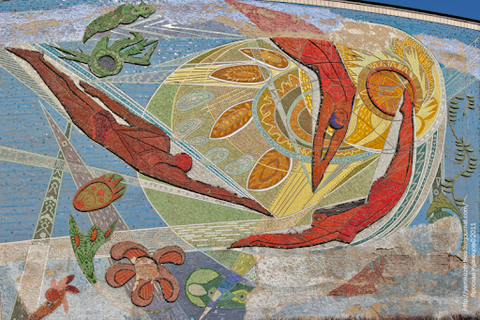
Their persecution, banishments to concentration camps, and other punishments were fuel for remaining members of the movement. As such, they were revered as heroic figures. After Ukraine gained their independence in 1991, many of these mosaics were celebrated and preserved. A 2002 campaign assured the relocation and preservation of works like “Woman-Bird” - now a casualty of shelling in Kyiv.
In general, an interest in cataloging and preserving the widely-scattered examples of Soviet-era monumental mosaics evolved. Kyiv-based photographer Yevgen Nikiforov has been heavily involved in the project. As such, the London exhibition expanded on Yevgen’s Ukrainian Soviet Mosaic project, which developed over eight years and covered towns across Ukraine.At the same time,it examined the Soviet cultural heritage in Ukraine and the critical local attitude towards it.
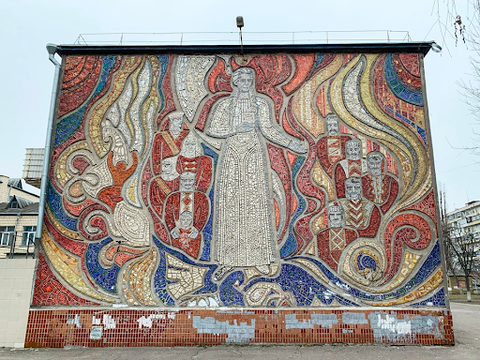
“Three years ago, we collected dozens of the most interesting mosaics for an animated projection to take a new look at the monumental art of Ukraine in the 20th century,” said Yevgen Nikiforov, the curator of Discover Ukraine: Bits Destroyed, ahead of the exhibition.
He continued: “Now, these unique objects are under threat, like the entire Ukrainian heritage. Through the display of these works in London, we will inscribe this layer of Ukrainian culture, still not sufficiently studied, in the history of world art.”
How was this possible? With a blend of the latest technology and existing architecture, immerse visitors were immersed in a motion-activated spectacle of 56 monumental mosaics created by Ukrainian artists between the 1960s and the 1980s. The exhibition was produced by the Ukrainian Institute, the creative team of Rock 'n' Light Studio, with music provided by Ukrainian multi-genre instrumental duo Ptakh Jung.

Image source British Council
After dark, brightly colored, hyper-intricate digital projections of mosaics The fleeting projections were accompanied by striking sounds that drew attention to both Ukraine’s cultural legacy and losses.

Image source British Council
In all, the exhibit included an alarming message, that most of the glorious pieces of art have already been destroyed in the ongoing war.
So much can change in a short time. The current installation was originally created in 2019 as a celebration of the Ukrainian mosaic tradition. It now attempts to reimagine the mosaic art form with the purpose of raising awareness about the destruction of cultural heritage and the importance of preservation.

Image source Soviet Mosaics in Ukraine
Commenting on the exhibition, David Codling, Ukraine UK Season Director at the British Council, said: “With its focus on art in public space, highly appropriate for the setting of the Greenwich+Docklands International Festival, this installation is an urgent reminder both of the danger to Ukraine’s cultural heritage and the vitality which sustains it.”

It’s incredibly timely, as the war continues. Speaking from Ukraine, Tetyana Filevska, Creative Director of the Ukrainian Institute, said: “Ukrainian culture is one of the targets in the Russian war against Ukraine. Since 24 February, we have lost hundreds of cultural objects around the whole country.”
“Art project Discover Ukraine: Bits Destroyed is animating images of the Ukrainian mosaics that were created in the middle of the 20th century,” she added. “This part of our heritage is difficult to preserve during the devastating war. A significant part of mosaics will not survive in it.”
Tetyana continued: “This project allows us to learn about Ukraine’s art that is being demolished by Russian bombs every day. It is a way to keep at least a memory of it as part of Ukraine’s rich heritage that the world has just started to discover.”
Relive the experience of this amazing multi-sensory art exhibition by visiting the video here:


