Close
Try Your Luck
With Mozaico
With Mozaico

Try Your Luck
With Mozaico
With Mozaico
Email Already Subscribed

we ship worldwide

money back guarantee

exclusive
630.300.3942
What can we help you with?
Shipping & Taxes. FAQ.630.300.3942
What can we help you with?
How to install a mosaic.Get one-on-one expert advice from our lead designer to help you transform any area around your home or work.
Fill out the form below to submit your designer question.
Take a picture of a room in your home, a floor area or a table top that you would like to ask a question about - or simply anything you would like to make into mosaics.

Mosaic is one of the oldest art forms still in continuous practice, and it has accumulated some genuinely odd history along the way. Ten things worth knowing, then the Roman facts people usually come looking for, and what actually defines the medium.
If you want the straightforward explanation instead, start with what mosaic art is.


The earliest known mosaics are from Mesopotamia in the third millennium BCE — cones of baked clay pressed point-first into mud walls to form patterns. Not tesserae as we would recognise them, but the same idea: an image assembled from many small units.
Floors are what survive best, which skews the picture. Mosaic has always also gone on walls, vaults and ceilings, into jewellery and small objects, around pools and across fireplace surrounds.
Colour in a mosaic comes from the material itself — the stone or the glass — not from pigment applied to a surface. There is nothing to bleach. A two-thousand-year-old Roman floor is still the colour it was laid.
Byzantine gold is a sheet of gold leaf fused between a glass base and a fine transparent film. The glass protects the metal, which is why it still gleams. More on that in our guide to Byzantine mosaics.
The direct method sets pieces straight into the bed. The indirect method assembles the design face-down on paper and transfers it. The double indirect method does the same but keeps the design the right way up throughout. Each suits different work — see the four methods of making a mosaic.
Before anyone cut a cube, Greek mosaicists sorted naturally rounded pebbles by colour and set them in mortar. Cut stone, then glass, then everything since — our guide to tesserae and mosaic stones covers the full range.
Not one tradition but several: Greco-Roman, Byzantine, Islamic geometric tilework across Spain, Morocco and Persia, and pre-Columbian work in Mesoamerica using turquoise and shell.
Mosaic is usually part of a building rather than hung on one — which is why so much of it has to be visited rather than borrowed for exhibitions. Our guide to cities worth visiting for their mosaics is the travel version of that fact.
Design has moved to screens and in some cases to AI, but the cutting and setting are still done by hand, piece by piece, because the decisions are too small and too numerous to hand over.
Sorting and placing hundreds of small pieces is repetitive and demands just enough attention to crowd other thoughts out. Mosaic is also used as a medium within art therapy, which is a specific clinical practice rather than a property of the craft — our guide to mosaic and art therapy explains the difference.

Rome is where most people meet the medium, and it is the most-asked-about period by a wide margin.
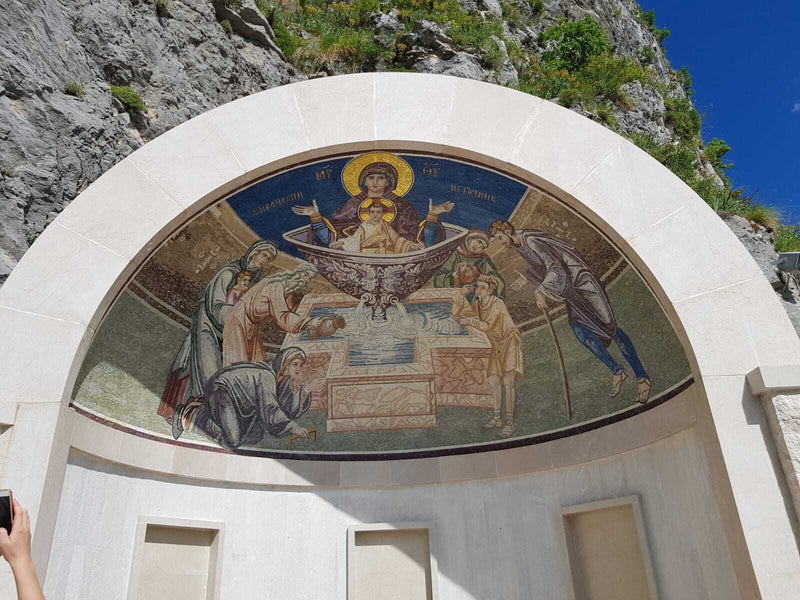

What actually distinguishes mosaic from other picture-making.
| Characteristic | What it means |
|---|---|
| It is assembled, not drawn | The image is built from discrete solid units. There is no continuous stroke anywhere in it |
| Colour is material | The colour is the stone or the glass, not a pigment on top of it, so it does not fade |
| Andamento | The direction the rows of tesserae flow. It carries movement and form, and getting it wrong makes a mosaic look flat |
| The gaps are part of it | The lines between the pieces read as a fine mesh over the whole image. Grout colour changes the picture |
| It resolves with distance | Close up you see pieces; step back and they become an image. A mosaic is designed for a particular viewing distance |
The last two are what makes mosaic hard to photograph well and much better in person.
Designer picks · Abstract mosaics · History of mosaics · Custom mosaics
They are around five thousand years old; the colour comes from the material rather than pigment so it never fades; Byzantine gold tesserae are gold leaf sealed inside glass; and despite every advance in design software, the cutting and setting are still done entirely by hand.
The Romans produced them across the whole empire; they used opus tessellatum for broad fields and opus vermiculatum for fine detail; the finest central panels were often workshop-made and shipped in; black and white was the Italian fashion and polychrome the provincial one; floors used stone while glass was kept for walls; the Alexander Mosaic at Pompeii contains well over a million pieces; one Pompeian doorway reads cave canem; Villa Romana del Casale in Sicily holds the largest surviving collection; subjects ranged from gods to uneaten food; and new floors are still being uncovered, usually by builders.
It is assembled from discrete units rather than drawn; its colour is the material itself and does not fade; the flow of the rows, called andamento, carries the form; the gaps between pieces are part of the image; and it resolves into a picture only at a distance.
About five thousand years. The earliest known examples are clay cones pressed into walls in third-millennium-BCE Mesopotamia.
A single piece in a mosaic — one cut cube of stone, glass or ceramic. The plural is tesserae.
Stone and glass do not rot, fade or burn, and the pieces are bedded in lime mortar that sets into a single mass. Buried mosaic survives far better than paint, timber or textile, which is why so much of what we have was dug up.
Floors, walls, splashbacks, pool linings, fireplace surrounds, table tops and standalone panels. What is mosaic art covers the modern uses in more detail.


